

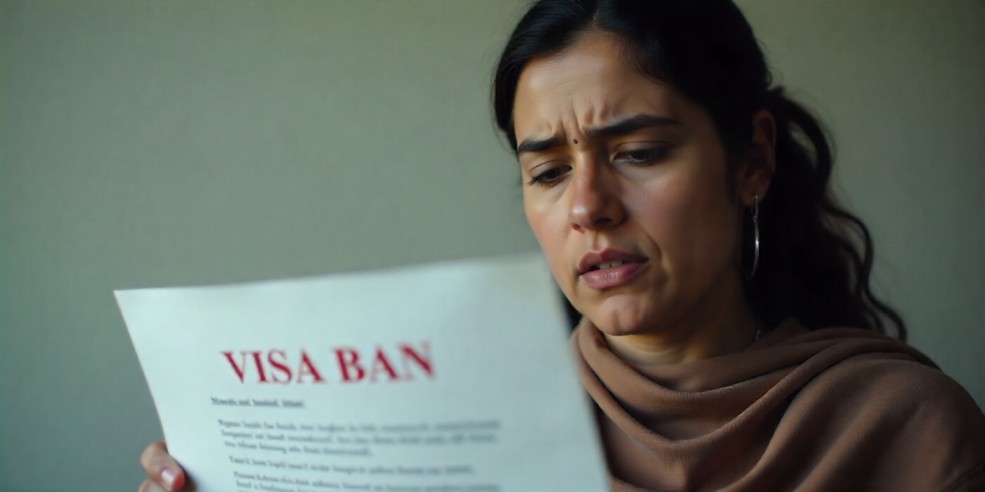
Home Secretary Shabana Mahmood Considers Trump-Style Visa Ban. Today, Shabana Mahmood will present “the most sweeping reforms to tackle illegal migration in modern times” in a speech to the House of Commons.
As part of “sweeping reforms” to the UK’s immigration system, Home Secretary Shabana Mahmood intends to slap Trump-style visa bans on three African nations if they fail to repatriate unlawful migrants.
If Angola, Namibia, and the Democratic Republic of the Congo do not enhance cooperation on removals, they will be subject to visa sanctions that will prevent their tourists, VIPs, and businesspeople from visiting to Britain.
“In Britain, we follow the rules,” stated Ms. Mahmood. I meant it when I declared that nations that refuse to repatriate criminals and undocumented immigrants would face consequences.
“My message to foreign governments today is clear: accept the return of your citizens or lose the privilege of entering our country.”
The Times claims that Kristi Noem, President Trump’s homeland security secretary, who has been in charge of the country’s mass deportation policy, was the driving force behind the action.
In her speech to the House of Commons today, Ms. Mahmood will outline “the most sweeping reforms to tackle illegal migration in modern times”—basically, since the Second World War.
The goal is to make the UK less appealing to undocumented immigrants and facilitate their deportation. It is based on the Danish approach.
The plans call for the home secretary to introduce a bill that would alter the application of article 8 of the European Convention on Human Rights (ECHR), which guarantees the right to family life, in immigration court proceedings.
According to the Home Office, the use of rights-based appeals to evade deportation has increased recently.
In the future, only people with direct family in the UK—such as a parent or child—would be eligible to exercise Article 8.
The 73-day-new home secretary also intends to amend the law to prohibit repeated appeals of asylum denials.
In addition, refugees would have to wait 20 years to qualify for permanent residency.
According to the Home Office, asylum requests in the UK have increased as a result of the “golden ticket” agreement, which has drawn migrants from all around Europe through secure nations onto perilous tiny boats.
The proposals would deport refugees whenever their home countries are judged safe, and refugee status would become transitory and subject to regular assessment.
Additionally, weekly allowances and housing would no longer be guaranteed.
In an effort to reduce risky cross-Channel travel, the reorganisation also calls for the establishment of safe and authorised routes to the UK.
Last-minute appeals would be expedited, and a new independent authority akin to one in Denmark is envisaged to expedite the deportation of dangerous criminals.
Ms. Mahmood has refuted claims that her ideas are “racist,” characterising them as a “moral mission.”
“Huge divides” were being caused by illegal immigration in the UK, she claimed, adding, “I do believe we need to act if we are to retain public consent for having an asylum system at all.”
What policies will be announced by the home secretary?
- People will be susceptible to expulsion as soon as their home countries are judged safe, and their refugee status will become temporary and subject to frequent assessment.
- Before they may petition for permanent settlement, asylum applicants will have to wait 20 years.
- For individuals who are truly escaping persecution and conflict, new, safe, and legal pathways will be implemented.
- Amid concerns that Article 8 of the European Convention on Human Rights has been used to thwart removals, changes to the legal framework would oblige courts to put public safety ahead of migrants’ rights to a family life.
- Using facial age estimate technology, a type of artificial intelligence, to quickly determine an individual’s age in an effort to discourage those who pose as minors in order to apply for asylum
- There will also be limited employment and educational opportunities for refugees.
Ms. Mahmood stated that she had seen how illegal immigration has been “creating division across our country” in an interview with Trevor Phillips on Sunday Morning.
“I can see that it is polarising communities across the country,” she continued. I can see how it is causing individuals to become estranged from one another. I don’t want to witness that occur in my nation from a distance.”
“Britain has always been a fair, tolerant, and compassionate country—and this government will always defend those values,” stated Prime Minister Sir Keir Starmer.
However, people need to know that our borders are secure and that laws are upheld in a more unstable world. Endless appeals, last-minute claims, and the expulsion of those who have no right to be here will all be stopped by these reforms.
Kemi Badenoch, the leader of the Conservative Party, praised Ms. Mahmood for “finally talking seriously about tackling illegal immigration” but described the ideas as “weak.”
“If the home secretary truly wants to reduce illegal immigration, she should take up my offer to sit down with her and work on a plan that will actually stop the boats, rather than a few weak changes that will meet the approval of Labour MPs,” she stated.
Nigel Farage, the head of Reform UK, stated earlier on Sunday: “The home secretary sounds like a Reform supporter.”
He continued, “Unfortunately, the Human Rights Act and ECHR membership will prevent the changes from being upheld by the courts or even her own backbenchers.”
The Refugee Council cautioned that reviewing asylum seekers’ eligibility to stay in the UK would cost the government £872 million over a ten-year period.
The chief executive of the charity, Enver Solomon, stated that although the modifications will unfairly hinder men, women, and children from assimilating into British society, they won’t stop individuals from undertaking risky crossings.
According to the most recent Home Office data, 39,075 persons have entered the UK this year after travelling across the English Channel in small boats.
The overall number of arrivals is less than that of 2022 (45,774), but it has already surpassed that of 2024 (36,816) and 2023 (29,437).