

New Rules for UK Spouse Visas in 2026
Important Points
People who want to get a UK spouse visa need to know about the rules that are in place at the time of their application.
In 2026, new candidates for a spouse visa must have a minimum salary of £29,000.
As of 2026, the five-year settlement procedure for spouses of British nationals is still the same.
If enacted, earned settlement consultation ideas could change the ILR route for work visa holders’ dependents.
The UK spouse visa is a key part of arranging for long-term relocation. For a lot of people, whether they are on Skilled Worker visas, business routes, or other types of visas, the fact that their spouse or partner can join them in the UK is a big part of their considerations about UK-based work, moving, and family life in the medium and long term. It decides if British residents living abroad can afford to come back home with a partner.
Changes to the UK spouse visa rules have effects that go far beyond the family route itself. They affect choices about jobs, when to move, how to organise childcare, and plans for long-term living.
Section A: Changes to the UK Spouse Visa
The rules that apply to UK immigration law are those that were in effect on the day the application was made. Changes to the threshold, the terms of settlement, or the requirements for new earnings might all change who is eligible. The Immigration Rules that were in place when the application was made are used to judge applicants, no matter when planning started.
In April 2025, the UK spouse visa rules got a lot stricter. For new applications, the minimum income criterion was up from £18,600 to £29,000. That one adjustment left out a lot of possible sponsors and changed how families planned their finances.
Because of the government’s earned settlement ideas, new regulations for possible spouse visas could go into effect in 2026. Any changes to ILR are likely to make individual economic contribution a requirement, which could make it even harder for families to move to the UK.
Section B: New Rules for UK Spouse Visas in 2025
The most important change to the spouse visa route in the last few years takes effect in April 2025.
For new applications, the minimum amount of money needed to sponsor a spouse went from £18,600 to £29,000 per year.
The £29,000 minimum does not apply to all spouse visa holders. Applicants who first applied under the former £18,600 barrier will get transitional provisions as long as they stay on the same route. Their applications for extensions and settlements are still being looked at based on the former financial level.
In late 2025, the Home Office made the suitability and rejection rules stronger for all types of immigration, along with the income increase. These modifications didn’t modify the basic guidelines for who can get a spouse visa, but they did make it more important to look closely at compliance history, past immigration violations, and evidence standards.
The 2025 changes made it harder for people who want to receive a spouse visa to enter the country and stay longer.
There have been no proposals to raise the threshold to £38,700, and there is no set date for when it will be raised again. Because of this, the income criteria is still the principal barrier to entry and extension for many British sponsors, and the possibility of future increases adds to the uncertainty.
Section C: Will the rules for UK spouse visas change in 2026?
Even if there have been calls for broader immigration reform, the situation for spouse visa applicants in 2026 is still rather limited. The minimum income criterion has not gone up since the £29,000 barrier was set in April 2025. There have been no changes to the basic partnership conditions, and there is no confirmation that the five-year settlement option for partners of British citizens has been extended.
That being said, the move to digital immigration status and eVisa systems is still continuing on in 2026. This merely changes how status is shown and handled; it doesn’t change the actual qualifying requirements for spouse visa applicants. Visa holders should check their UKVI account and make sure that their status and information are right in the Home Office system. This will help them avoid problems when checks are undertaken, as when they re-enter the UK under harsher conditions starting on February 25, 2026.
A lot of spouse visa applicants are worried that the government’s earned settlement reforms could change things for spouse visa holders at the ILR stage.
The earned settlement consultation suggests that the default qualifying time for many work visa holders should be extended to ten years and that payment should be linked to economic contribution. One important thing that is being talked about is a need for dependents of workers to have a record of taxable income beyond £12,570.
People are worried that non-working partners won’t be able to live with the main visa holder because of that idea.
- Does the £12,570 income requirement apply to visas for British spouses?
As of 2026, the projected requirement for individuals to earn £12,570 does not apply to spouses of British nationals. The consultation proposal is about dependents of workers on economic routes, such as Skilled Worker visas. It doesn’t change the family visa process for British citizens’ partners.
As long as they match the standards for residence, relationship, and suitability, spouses of British nationals can still settle in the UK after five years. At the ILR level, there is no separate limit on personal earnings. When someone applies for a visa or extension, the financial requirement is based on the income of the sponsoring partner, not the applicant’s own earnings.
There has not been a verified change to the law that would add a £12,570 earnings requirement to the British spouse visa route. It is not true that such a requirement is already in place.
- Why is the reform still important to talks about spouse visas?
The plan doesn’t change the rules for British spouse visas right now, but it does show that the government is putting more emphasis on economic contribution as a condition of settlement. That focus has already affected the rules for family migration at the entry stage. The rise in the sponsorship barrier to £29,000 in April 2025 showed that family pathways are not immune to changes in migration policy that affect the economy as a whole.
The earned settlement consultation adds contribution-based criteria to compensation for workers and their dependents. There is no clear plan to require British spouse visa holders to take an individual earnings test, but the policy is moving in the direction of making long-term residence more firmly linked to measurable economic activity.
For applicants, the important thing is to plan ahead. The Immigration Rules in effect on the date of application set the rules for settlement. When change is being spoken about, families need to think carefully about timing, route structure, and long-term eligibility.
The rules for British spouse visas are still the same as they were before. The results of the consultation will decide whether contribution-based settlement stays limited to economic pathways or grows even more.
- Family members of skilled workers
If the sponsoring partner has a Skilled Worker visa instead of British citizenship, settlement planning works under a distinct risk profile.
The government’s earned settlement consultation says that dependents of workers may need to show that they have made more than £12,570 in taxable income in order to be eligible for Indefinite Leave to Remain. That criterion isn’t in place right now. At the moment, dependents settle at the same time as the main visa holder, and there is no separate income test.
If the proposal is passed as it is now, it will change that alignment. Even if the main applicant is eligible for settlement, a spouse who doesn’t work could still be on limited leave. In real life, families could have to deal with staggered timelines, where one partner is settled and the other has to keep extending their visa.
This has effects that go beyond just status. Delayed settlement can make it harder for kids to get student loans, hurt their long-term security, and make it harder for them to become citizens in the future. For families who just have one income, the suggestion adds a risk that isn’t already part of the settlement approach.
It’s crucial to be clear about where things stand right now. The plan for £12,570 in earnings for dependents of workers is still being talked about. It doesn’t change the five-year settlement route for spouses of British citizens, and there is no necessity for independent earnings on that route.
But the consultation makes it clear that the policy is focused on each person’s economic contribution. If the reform goes through, it may become more vital for families that are sponsored through work channels to know early on how long it will take to settle and how much money they will make.
The ultimate decision will rely on what happens in the consultation and any new Immigration Rules that come out after that.
Section D: DMS Point of View
For families that want to move to the UK or stay there for a long time, one of their main concerns will be how swiftly the visa and settlement system can change before they apply. The income increase in April 2025 showed that qualifying thresholds can change swiftly and without long transition periods for new candidates.
The situation for British spouse visa applicants looks steady right now, but the earned settlement consultation shows that the government is still focused on economic contribution. If contribution metrics become more widely used across routes, settlement planning may need to look at income structure, application time, and route selection sooner.
So, applicants should focus on whether their current income meets the current thresholds without relying on future projections, whether waiting to apply exposes them to possible rule changes, and whether the immigration status of their sponsoring partner affects their long-term settlement strategy.
In short, if you want to arrange for a spouse visa in 2026, you need to know about changes in the law that could affect the rules.
Section E: Need Help?
If you want to apply for a spouse visa in 2026 or are trying to figure out how recent and proposed rule changes might influence your eligibility or settlement timeframe, getting legal guidance early will help you make smart choices. You can talk to one of our UK immigration consultants over the phone for a fixed cost to go over your situation.
Section F: Common Questions About Changes to UK Spouse Visas in 2026
Have the rules for UK spouse visas changed in 2026?
There haven’t been any fresh adjustments to the entry-stage rules in 2026. For new applicants who are not covered by transitional protection, the minimum income criteria is still £29,000. The five-year settlement route for spouses of British nationals is still open.
Did the income criterion for a spouse visa go up to £38,700?
No, a greater threshold was suggested, but it was never put into place. The minimum income criterion is still £29,000.
Do people on spouse visas have to meet the £12,570 income requirement?
No. The proposed £12,570 individual earnings threshold is for dependents of economic migrants as part of the earned settlement consultation. It doesn’t apply to British citizens’ spouses right now.
Are they going to make the five-year spouse visa settlement path last ten years?
Not for people who are married to British citizens. The ten-year default settlement plan applies to many economic migration routes that are being looked at, but the timescale for settling a British spouse visa has not been changed yet.
Could changes to earned settlement in the future have an effect on spouse visas?
There is no official plan to add a requirement for individual earnings to the British spouse visa route. There is still time for adjustments to be made to settlement reform, though. The rules that were in place when the application was submitted are used to judge it.
What do people who want to get a spouse visa in 2026 need to think about?
People who want to apply should make sure they meet the existing income criteria of £29,000, check if transitional protection applies, and think carefully about when to apply if there are discussions about changing the rules in the future. Planning ahead lowers the danger of not being eligible.
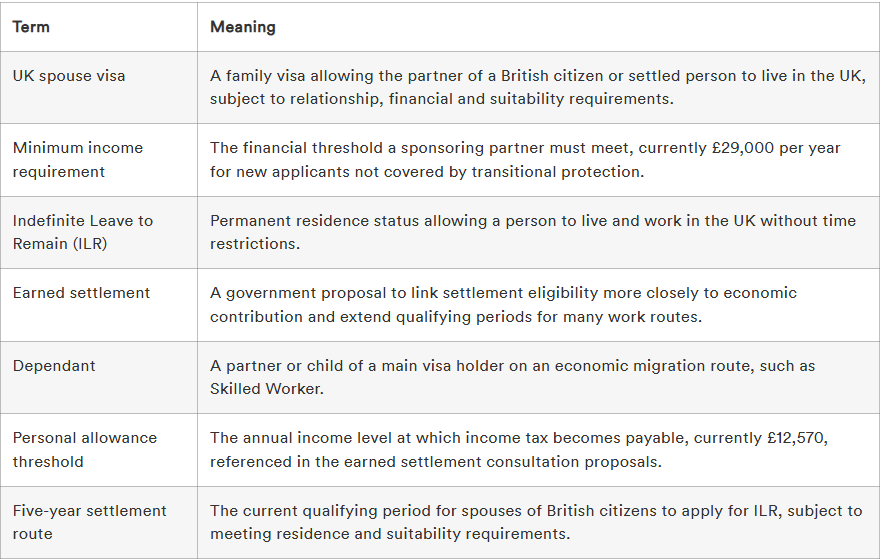
Section G: A list of terms
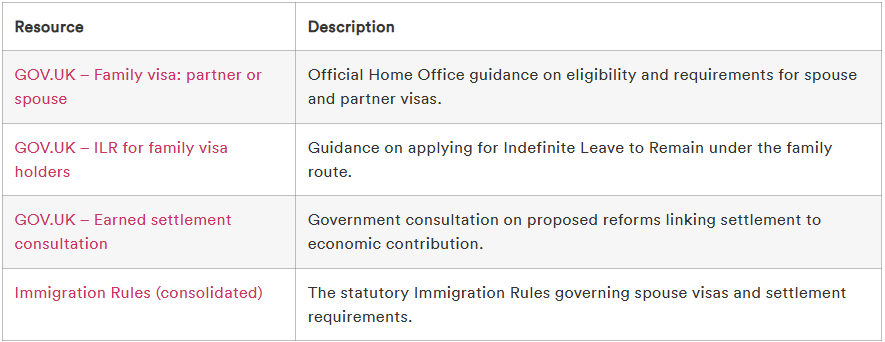
Section H: Helpful Links