

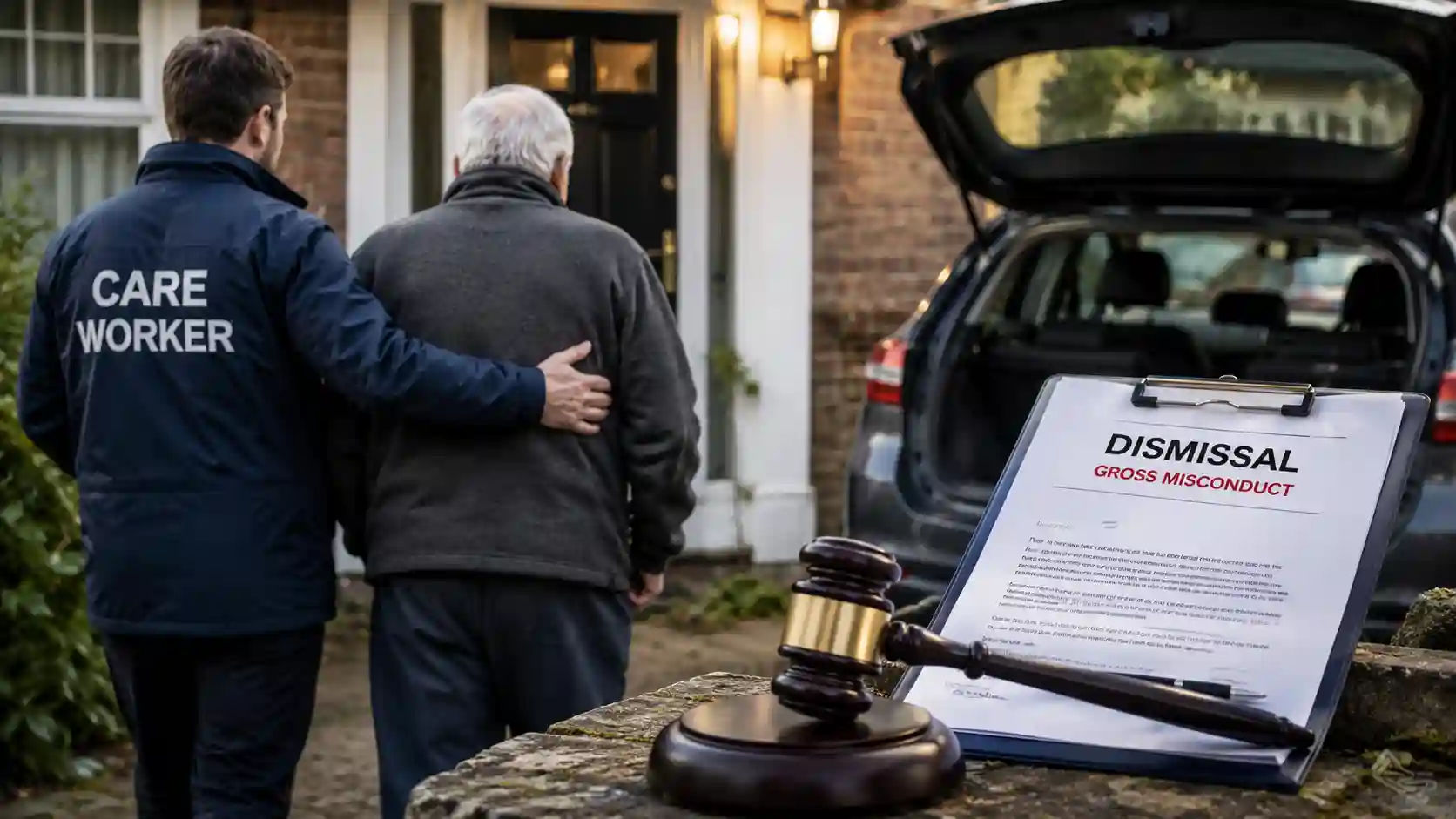
Employment Tribunal Upholds Dismissal for Gross Misconduct
A care provider was entitled to sack a support worker for escorting a vulnerable service user to his family home on New Year’s Day, an employment tribunal in Glasgow has found.
Mr McPhail, who had worked for Lifeways Group since August 2018, was sacked for gross misconduct after taking the disabled service user to his home to spend New Year’s Day with his family. He said he was acting out of goodwill after the service user’s family said they could not accommodate him and he insisted he had the individual’s best interests at heart.
The service user was supported by McPhail and two other support workers on a 24-hour basis. The tribunal was told the welfare guardianship of the service user’s sibling had expired by the time of the occurrence.
The issue was raised with management by a social worker in February 2025 and an investigation was launched. The charge against McPhail was that he had failed to properly document the visit, had not declared a conflict of interest and had breached professional boundaries by forming a personal relationship with the service user.
Investigation into Professional Boundaries
The inquiry heard that McPhail denied trying to cover up what transpired.
“I wrote that he came to my house and had a wonderful New Year’s dinner with my family and me,” he claimed. “I even have pics of [the service user] at mine during it with my family and sent them to [the service user’s] brother he was very pleased with it.
The service user – who for legal reasons has to stay nameless – had a terrific time and even enquired when he was coming back, said McPhail.
McPhail admitted at the disciplinary hearing that he had violated a professional boundary but claimed he believed he had acted responsibly in challenging circumstances.
“We had been through a bad patch in the service. Staff had left and one long-serving staff member had died. “It was a madhouse,” he told.
“[Service user] was self-harming, upset and asking for [staff member who died] The family then claimed the [service user] could not go home with them for new year’s day. I suggested to the family that I could take him to my home for new year’s day and they agreed to this.”
He added: “I thought I was doing a good job I did step over a line but I always had the best interests of the [service user] in heart.”
Gross Misconduct Finding
Misconduct, serious
McPhail was found guilty of gross misconduct by Lifeways for crossing professional boundaries and putting the service user and his own family at unnecessary risk.
The business said in its dismissal letter:
“Suggesting and agreeing to take [the service user] to your home with your family members present is a breach of boundaries and you did so fully aware of the identified risks associated with [the service user].
You not only put [the service user] at risk, but you also put yourself and your family members at risk.
The employer also ruled that McPhail did not know that the local authority, not the service user’s brother, had guardianship and claimed he was not permitted to make the decision without management clearance.
Employer Considered Alternatives Before Dismissal
Dismissal alternatives
But other options, including demotion and retraining, had been explored by the corporation before dismissing him, said Keith Anderson, Chair of the Lifeways disciplinary committee. It was especially severe, he said, since the claimant did not see what had happened as a conflict of interest or a breach of professional boundaries when a risk assessment would have shown the true risks. Anderson told the tribunal he had worries about the claimant not grasping the gravity of his acts. He took into consideration McPhail’s years of service and his previously pristine record, but it was all the more reason he should have known better.
Employment Tribunal Decision
Employment Judge Muriel Robison said that McPhail had been a dedicated care worker and understood why he had felt aggrieved by his dismissal and dismissed the unfair dismissal claim.
“The claimant’s representatives asked the tribunal to accept that the claimant was a professional and considered carer in a 24/7 service in the service user’s home and I have no reason to doubt that,” she added.
“I understand the claimant’s view that he has been treated harshly for what he says was ‘an act of kindness’ in difficult circumstances at work, and I do not think it was serious enough to warrant his dismissal.”
But she stressed the tribunal’s mission was not to substitute its perspective for that of the employer.
“There are a number of appropriate remedies possible to an employer and even if this tribunal finds that dismissal was too harsh in the particular circumstances, the particular setting in which the respondent works implies that what may be reasonable in one situation is not reasonable in another.
Tribunal Highlights Importance of Professional Boundaries
Sensible replies
I could not argue, therefore, that dismissal in the unique circumstances of this case was unreasonable since dismissal for egregious misbehaviour was within range of acceptable responses possible to the respondent. The suit thus must be dismissed.”
The judgement underlines the importance of maintaining professional boundaries in care settings and demonstrates that tribunals are likely to afford employers a wide margin of appreciation in safeguarding concerns and conflicts of interest where an employee’s actions were driven by compassion.
Key Takeaways
- A Glasgow employment tribunal ruled that the dismissal of the care worker was fair.
- The support worker was dismissed for gross misconduct after taking a vulnerable service user to his family home.
- The employer found that professional boundaries had been breached and safeguarding procedures were not followed.
- Alternative disciplinary options were considered before dismissal.
- The tribunal confirmed that employers in care settings have broad discretion when dealing with safeguarding and conflict-of-interest concerns.
- The judgement reinforces the importance of maintaining professional boundaries, proper documentation, and management approval when supporting vulnerable service users.