

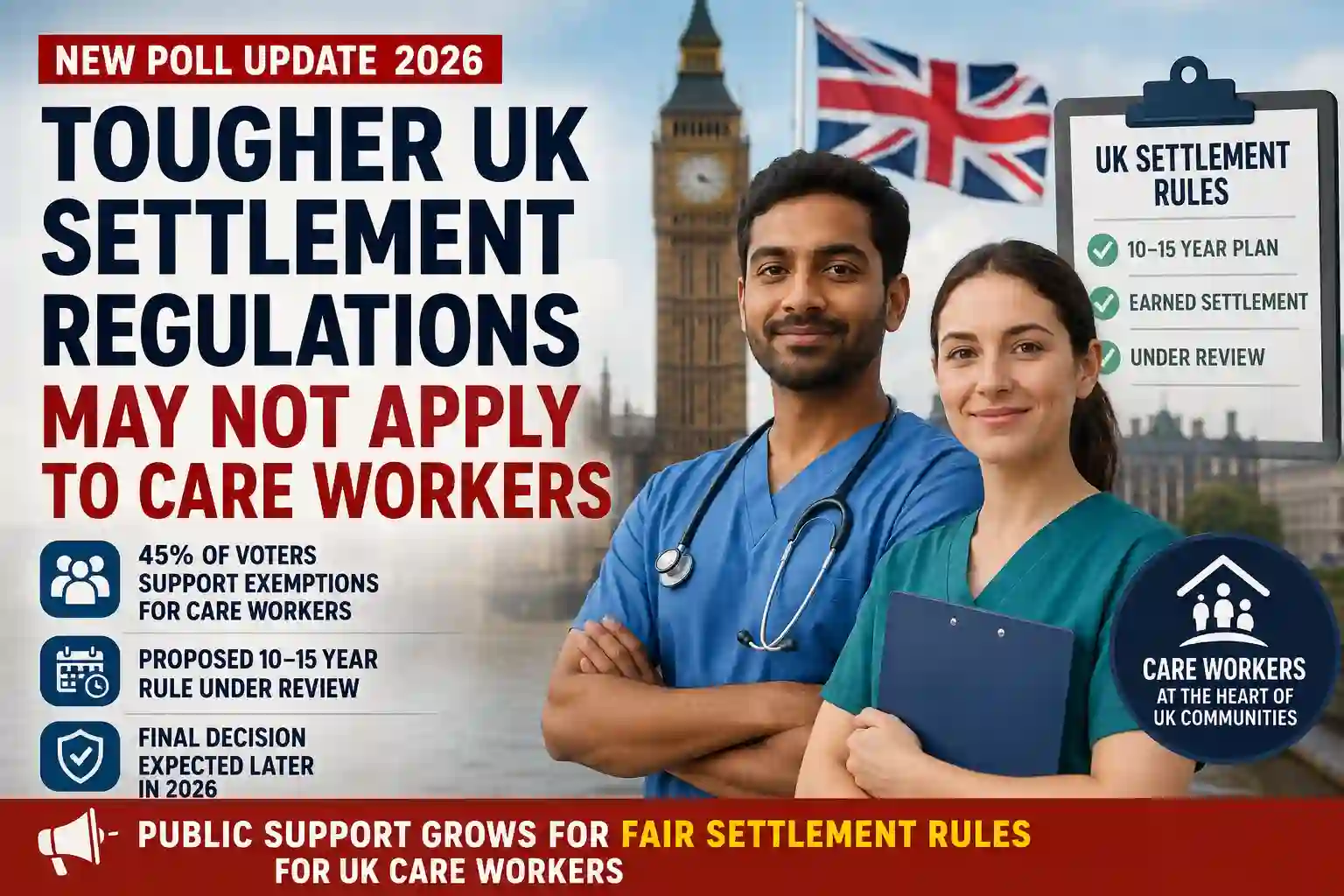
Main news: Tougher UK settlement regulations may not apply to care workers
Nearly half of UK voters, according to a recent poll, think that foreign health and care workers who currently reside and work in the country should be shielded from the government’s planned stricter settlement regulations.
What is the government suggesting?
The eligibility requirements for Indefinite Leave to Remain (ILR), the privilege to live permanently in the UK, are being significantly altered by Home Secretary Shabana Mahmood.
In accordance with the suggested “earned settlement” system:
- The typical qualifying time can be extended from five to ten years.
- The qualifying time may be 15 years for some lower-paid workers.
- Migrants who are highly talented or otherwise eligible may be able to settle sooner.
- Instead of limiting the new system to newcomers, the government is thinking of implementing it for those who already reside in the UK.
What does the latest survey reveal?
On August 25–26, 2026, 1,579 persons in Great Britain participated in the BMG Research survey for The i Paper.
The findings indicate:
- According to 45% of respondents, immigrants who currently reside and work in Britain ought to be exempt from the new settlement regulations.
- 33% think that those who are already in the UK should be subject to the new regulations.
- Lower-skilled health and care professionals should be excused, according to 45% of respondents.
- Merely 26% of respondents are in favour of implementing the suggested “earned settlement” modifications for those healthcare providers.
What makes carers so crucial?
The problem is important since there is currently a severe staffing shortage in the UK social care industry.
According to the survey, there are roughly 96,000 open positions in social care on any given day, and by 2040, the industry is predicted to need an additional 410,000 workers.
Because of this, Labour MPs and unions are worried that making current foreign care workers wait a long time for permanent settlement may make it more difficult to fill open positions and keep skilled staff.
Additionally, the UNISON union has cautioned that changes in immigration are adding to the strain on social workers.
Disagreement among workers on the proposal
Within the Labour Party, there is controversy over the plan.
The Home Secretary is being pressured by certain Labour MPs to provide protection to individuals who entered the country under the old immigration laws and have already made their homes and careers here.
Immigration Minister Mike Tapp, who openly urged that foreign care workers should be excused from the longer settlement time, has also been involved in political controversy.
As a result, the government is debating whether to:
Exempt carers or all immigrants already residing in the UK from the new settlement regulations.
What about advantages?
The timing of migrants’ access to welfare benefits upon settlement may potentially be impacted by the proposed revisions.
Based on the survey:
- According to 44% of voters, immigrants should wait three to four years after settling down before receiving benefits.
- According to 37% of respondents, benefits should be given to migrants as soon as they are settled.
Why is the government promoting these changes?
The growing number of individuals qualifying for permanent settlement worries the government.
In June 2026, around 200,000 persons received ILR, which is said to be the greatest number in 16 years. The government is worried that many immigrants who came during the peak migration period would soon be eligible for permanent residency.
People who came through the Health and Care route are expected to make up a particularly sizable future settlement cohort, according to the Home Office. According to their consultation, 462,000 people from that route might be settled between 2026 and 2030 based on past settlement trends.
Crucial for present and prospective carers in the UK
This does not imply that carers have already received an exemption.
As part of the settlement revisions, the exemption is presently under consideration. Later in 2026, the final decision is anticipated.
Furthermore, settlement and ILR are the main issues here, not the quick revocation of current care worker visas.
Separately, the recruitment of foreign care workers has already seen substantial improvements in the UK. While transitory in-country solutions are still available until July 2028 under certain situations, government regulations have stopped new overseas skilled worker entry-clearance applications for care workers and senior care workers.
The bottom line
The key takeaway from this i News story is that public opinion seems to be shifting in favour of shielding healthcare professionals who are currently employed in the UK from the proposed stricter settlement regulations.
Nevertheless, a definitive exemption has not yet been established. The final settlement strategy is anticipated later this year, and the Home Secretary is still weighing her options.
The safest headline for a UK visa sponsorship or employment website would be:
“A New Poll Shows Strong Public Support for Exempting UK Care Workers from Proposed 10–15 Year Settlement Rules”
Instead of falsely stating that an exemption has already been accepted, that phrase makes it obvious that one is being considered.