

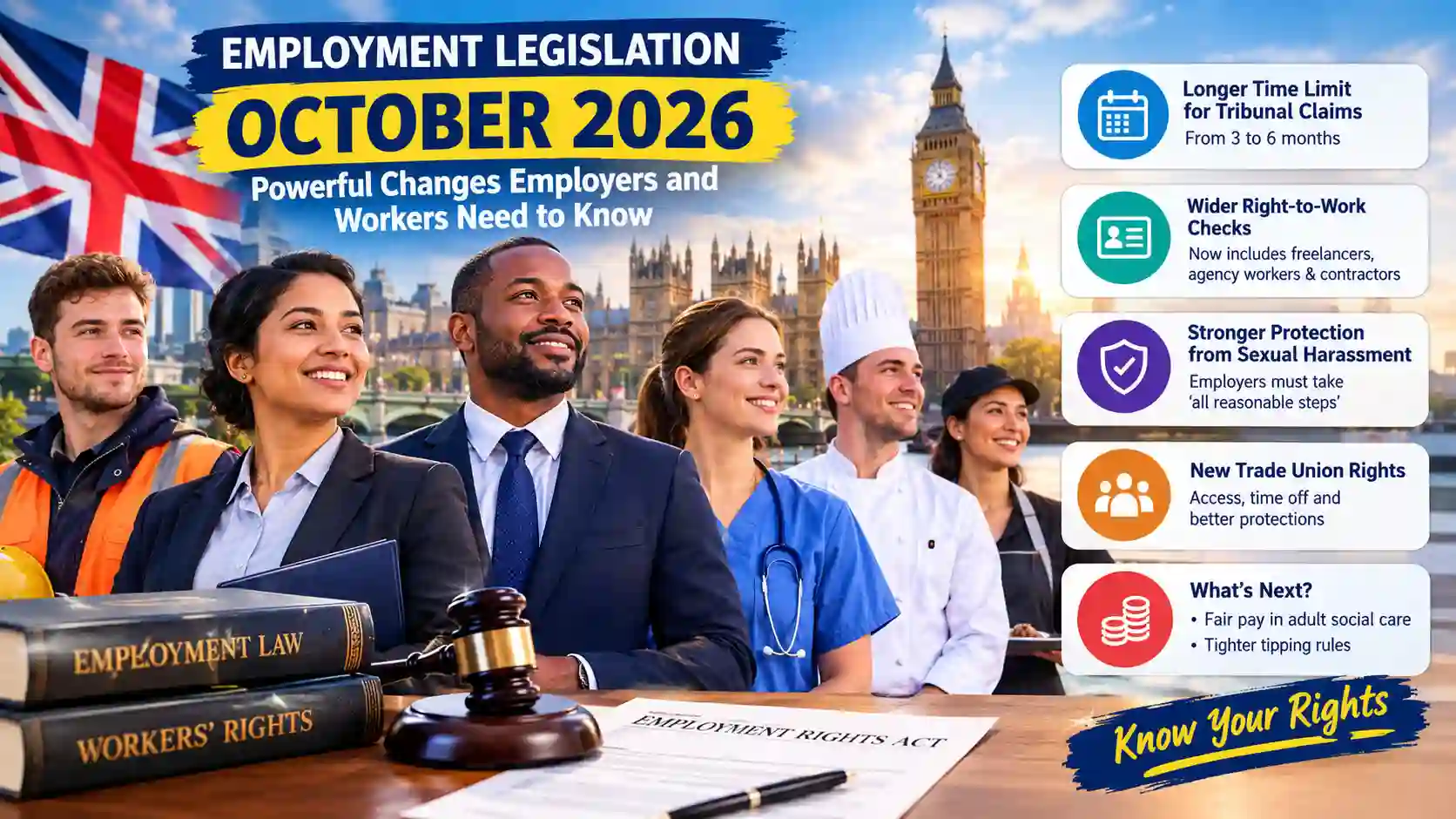
Employment Legislation October 2026: The Employment Rights Act has now been in force for ten months and a number of modifications are set to take place in October, both at the beginning and the end of the month. Here is a quick description of the major changes and what you should expect.
Expanding the scope of employment tribunals
From 1 October, the Employment Rights Act 2025 (ERA) doubles the time limit for bringing an employment tribunal suit from three months to six months.
Where the incident (or series of events) covered in the claim happens on or after 1 October 2026, the lengthier limit shall apply.
The longer deadline allows the parties more time to conciliate and settle early, but other legal experts say the extension would prolong uncertainty and add to the current backlog of the tribunal.
But there’s one introduction stalled in Scotland. The six-month restriction for bringing breach of contract claims in employment tribunals in Scotland will apply from 9 November 2026. Until then, there’s the three-month limit.
Right-to-work checks are increasing
This is not a reform contained in the ERA, but on 1 October the UK’s right-to-work regime will be greatly extended.
From this date employers must expand their right-to-work checks to freelancers, agency workers and contractors — those that have been historically seen as outside the purview of compliance – beyond ‘traditional’ employees.
This is an amendment to the Immigration, Asylum and Nationality Act 2006.
Failure to do so might lead to heavy fines. The maximum civil penalty for employing an illegal worker is presently £45,000 for a first infringement and up to £60,000 for consecutive breaches.
An organization that knowingly employs a person who has no permission to work could also face criminal charges.
Employers need to verify the current guidance from the Home Office. This explains specific situations where a self-employed person will not need to be checked and gives more information on the new regime.
Greater responsibility to stop sexual harassment
There is an improvement in the duties of employers to safeguard workers from sexual harassment on 30 October. They currently have to take “reasonable steps to prevent harassment” of workers in the course of their job. The new duty requires them to take “all reasonable steps”.
The change in the law also means employers are responsible for harassment from third parties such as clients or consumers.
The third-party harassment provision applies to the three types of harassment prohibited by the Equality Act 2010, namely sexual harassment; harassment related to a protected characteristic; and less favourable treatment because an employee has rejected/submitted to sexual harassment or harassment related to sex or gender reassignment.
Personnel Today is holding a webinar on the subject on 6 October, in partnership with learning provider VinciWorks. Sign up today.
Trade union changes under way
From 30 October, phase three of the trade union changes set out in the ERA came into force. This establishes a right of access to the workplace (physical and virtual) for the purposes of meeting, recruiting and organising workers, or to engage in collective bargaining.
This amendment will also oblige employers to offer reasonable accommodation and facilities to union representatives, create a right to time off for trade union representatives and improve protections against unfair practices during the statutory union recognition process.
Employers will be forbidden from treating workers detrimentally with a view to deterring, preventing, or punishing them for conducting industrial action.
However, one major trade union reform has been delayed to January 2027. Last week the government announced that an employer duty to provide a statement of workers’ right to join a trade union will now not be established until 1 January 2027.
The draft code of practice on trade unions’ right of access into workplaces sets out the procedures employers should follow when a union asks for access, and what happens if an agreement cannot be reached.
What to watch for later this year
New fair pay agreements in the adult social care industry
The ERA and larger Make Work Pay remit sets out the establishment of the Adult Social Care Negotiating Body for England, which had been pencilled in “by the end of 2026”, but is yet to be confirmed.
Tighter tipping rules
In 2024 new laws have been implemented to ensure that tips are distributed fairly and transparently, and to prevent employers from withholding service charges, tips or gratuities from their workers.
The ERA also mandated companies meet with representatives of workers in the creation or revision of tipping rules. They would have to evaluate their written policy at least once every three years.
This measure was due to take effect by the end of 2026. The government scrapped a draft code of practice on tipping in July after union criticism.