


82 UK Jobs That Can Get Visas in 2025. Jobs in the construction, healthcare, technology, defence, and creative sectors are among the 82 UK occupations on the Temporary Shortage List (TSL) that qualify for visas.
In summary, 82 UK positions in the construction, defence, life sciences, creative, and technology sectors are eligible for temporary visas through the UK’s Temporary Shortage List. Employers and migrants may manage change with the help of this handbook, which details applicable job codes, income thresholds, employer sponsorship requirements, visa duration, and dates through July 2026.
The Strategic Transition of the United Kingdom to Skill-Based Migration
One of the UK’s most ambitious immigration policies in recent years is a temporary shortage visa program that covers 82 UK positions in various industries that qualify for visas. The list of 82 UK jobs eligible for visas, which was created in collaboration with the Migration Advisory Committee (MAC), focusses on mid-skilled positions deemed essential to the country’s capacity and attempts to be open about which professions are eligible. The MAC says this action is part of a larger government plan to close critical workforce gaps while preserving immigration control and public trust. The MAC will review the 82 UK jobs eligible for visas through July 2026 and has been tasked with creating a time-limited plan that strikes a balance between economic urgency and sustainable workforce development. The UK Government’s immigration white paper, which outlines the framework and reasoning for the policy as well as the list of 82 UK jobs that qualify for visas, provides readers with official guidelines and background information.
This calculated move comes after a record-breaking net migration of 906,000 in the year ending June 2023, which sparked a national conversation about domestic training, wages, and labour dependency. Under the direction of Professor Brian Bell, the MAC has been entrusted with creating a focused, time-limited visa pathway that strikes a compromise between sustainable workforce growth and economic urgency.
The Temporary Shortage List’s (TSL) Justification
A Reaction to Labour Shortages in Important Industries
The UK’s industrial policy includes the Temporary Shortage List (TSL) to guarantee that critical industries including infrastructure, healthcare, defence, and the creative industries have enough workers. These professions, which bridge skills gaps that domestic workers cannot quickly cover, are regarded as “critical to national capability.”
According to Bell, “The government’s vision for the new temporary shortage list is to provide time-limited access to the immigration system for mid-skilled occupations where long-term shortages have been identified and deemed crucial to the delivery of the UK’s industrial strategy or critical infrastructure.”
What Makes a List Temporary?
This new list is intended to be short-term and specific, in contrast to earlier versions like the Shortage Occupation List (SOL). The MAC’s methodology guarantees that:
- The focus is solely on mid-skilled positions, such as HR officials, civil engineers, and carpenters.
- Employers are encouraged to upskill domestic workers by the time-bound nature of each visa path.
- Sectoral reviews will guarantee that inclusion is supported by actual data rather than advocacy.
The TSL exhibits regulated openness, enabling the contribution of foreign talent without fostering a sustained reliance on foreign employment.
The Information Supporting the Change
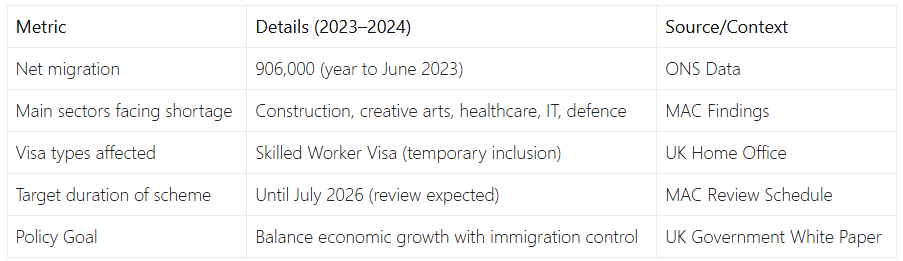
According to the MAC’s analysis, the UK’s labour participation rate is still below pre-pandemic levels, and sectors including healthcare, logistics, and hospitality are still under severe recruiting challenges. The government also wants to avoid becoming overly dependent on low-cost foreign workers, which has historically deterred investment in domestic skill development.
The Temporary Shortage List (TSL): An Overview
The mid-skilled group, which roughly corresponds to RQF Levels 3 to 5, is the foundation of the TSL and is comparable to associate degrees, vocational training, and diplomas.
Important Aspects of the Plan
- Visa Duration: Usually good for two to three years, but if shortages continue, it may be renewed.
- Salary thresholds: Sector-specific variances exist, however they are in line with the minimum requirements for skilled worker visas.
- Employer Sponsorship: Under the Skilled Worker route, employers are required to possess current sponsorship licenses.
- Sectoral Focus: Prioritisation of the life sciences, creative industries, infrastructure, and defence.
- Review Cycle: Through July 2026, the MAC will review qualified vocations once a year.
Flexibility and responsiveness, two policy attributes lacking from previous immigration systems, are made possible by this practical framework.
The complete list of 82 positions that qualify for temporary shortage visas
The 82 suitable vocations are categorised by key industry in the following table:
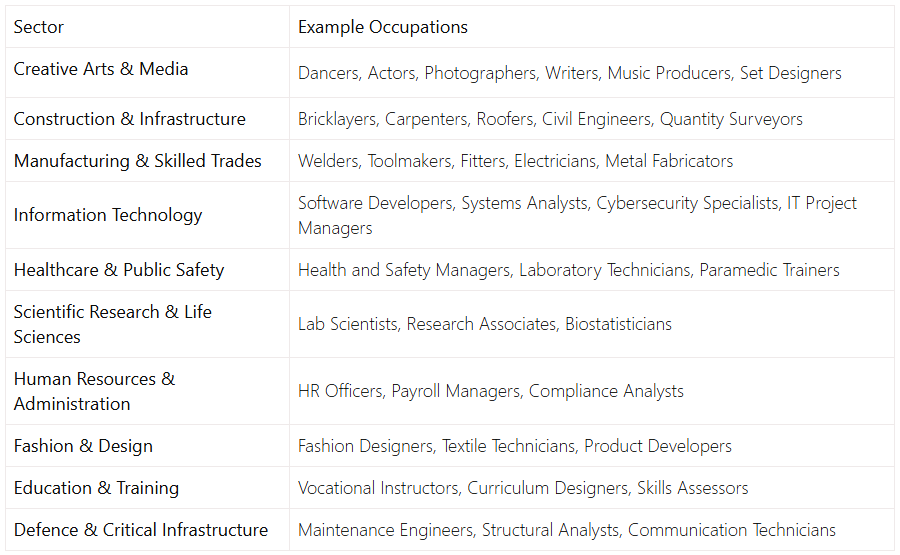
Note: After departmental and public participation, the final edition of this list will be reviewed by July 2026.
Why These Roles Are Now Needed in the UK
1. The boom in infrastructure and construction
Over the next ten years, it is anticipated that the UK will invest more than £600 billion in housing, transport, and energy. However, in order to fulfil demand, the Construction Industry Training Board (CITB) projects that more than 225,000 additional workers will be required by 2027.
Critical projects like HS2 and the UK’s net-zero infrastructure initiatives may be delayed due to a lack of workers in positions like bricklayers and civil engineers.
2. Industrial Security and Defence
The war in Ukraine and post-Brexit geopolitical realities have increased the UK’s emphasis on resilience in national defense. Project managers, communications specialists, and skilled engineers are essential to maintaining the UK’s defense supply chain. Immigration pathways that strengthen this talent pool have received explicit support from the Ministry of Defense.
3. Innovation and Life Sciences
Biotechnology, pharmaceuticals, and AI-driven healthcare are highlighted as major growth pillars in the UK’s 2021 government strategy, “Life Sciences Vision.” Innovation may be slowed by the lack of lab workers, research associates, and biostatisticians.
Refer to the UK Life Sciences Vision framework for additional context.
4. Cultural and Creative Sectors
From theatre to fashion, the UK’s cultural exports bring in nearly £115 billion a year for the economy. However, the loss of EU freelancers and the growing expense of creative visas have hampered the post-pandemic rebound.
The UK’s recognition of its global soft-power sectors is reflected in the inclusion of writers, painters, and designers in the TSL.
5. Cybersecurity and Technology
Even though the UK IT industry was valued at $1 trillion in 2023, there are still significant gaps in cybersecurity and software engineering.
According to a Tech Nation report, 78% of UK tech companies have trouble filling positions domestically, which supports temporary foreign hiring to maintain innovation.
Controlling migration while taking economic necessity into account
The difficulty facing the government is striking a balance between popular trust and economic competitiveness.
After Brexit pledges of stricter regulation and record net migration, immigration is still politically controversial.
Government’s Core Objectives
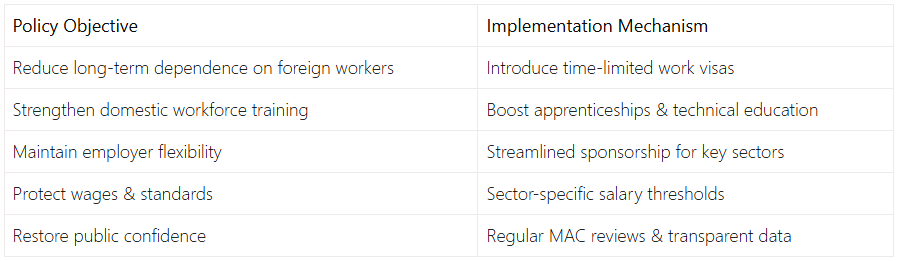
The May 2025 Immigration White Paper’s “skills-first” narrative, which clearly connects restricted migration to national growth priorities, is reflected in this strategy.
Comparative Perspective: How Different Countries Address Labour Shortages
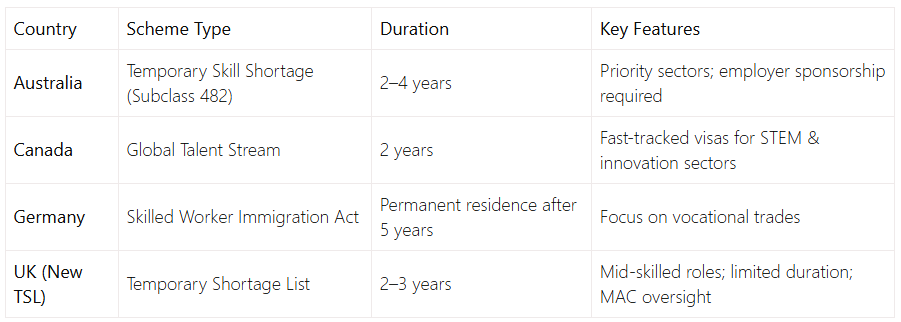
In contrast to Germany’s long-term settlement pathways or Australia’s high-skill orientation, the UK’s new model is notable for its emphasis on mid-skill. This illustrates London’s cautious policy development, which is both practical and politically aware.
Public Discussion and Criticism
Critics contend that temporary visas could cause uncertainty for both employers and employees, despite the fact that industry leaders have praised the proposal.
Issues Voiced
- Limited Duration: For qualified professionals, two-year visas might not be sufficient to cover the cost of relocating.
- Wage Disparity: According to some unions, a reliance on foreign labour could result in lower salaries in home markets.
- Problems with Retention: Employers may experience continuity issues if long-term residence is not an option.
- Administrative Burden: High sponsorship expenses and regulatory challenges are faced by small and medium-sized businesses.
In contrast to short-term migration solutions, sustainable workforce development necessitates concurrent investment in education, apprenticeships, and regional mobility, according to an analysis by the Institute for Public Policy Research (IPPR).
The Function of MAC and Policy Supervision
The UK Home Office receives impartial labour market advice from the Migration Advisory Committee (MAC).
Data-driven decision-making is emphasised in its most recent publications, which suggest that the TSL be revised yearly in light of:
- Surveys of employers
- Data on job openings from ONS
- Trends between wage growth and unemployment
- Disparities by region
This guarantees that the visa program will continue to be accountable and responsive, in line with the UK’s long-term industrial goals.
Future Prospects: From Short-Term to Long-Term Migration
1. Assimilation into the Industrial Strategy
The eight pillars of the government’s Industrial Strategy, which the TSL focusses on, include:
- Security and defence
- Healthcare and the life sciences
- The creative industries
- Technology and digital
- Construction and infrastructure
- Environmental sciences and clean energy
- Training in education and skills
- Production and transportation
The inclusion of each industry indicates both strategic significance for Britain’s 2030 economic plan and current shortfalls.
2. Policy Changes Expected by 2026
The MAC is anticipated to deliver by July 2026:
- A new shortage list that takes into account the state of the economy.
- Suggestions for combining mid-skill and high-skill visas into a single, efficient system.
- Policy support for regional migration models, especially to increase the workforce in northern England.
Effective implementation might turn the system into a permanent Skills Partnership Framework, bringing immigration, training, and education together under a single, unified framework.
How Employers and Job Seekers Are Affected
For Companies
- Simplified access to the Skilled Worker framework’s recognised job codes.
- Decreased red tape through the use of MAC-approved lists.
- Incentives for hiring migrants and training apprentices.
For International Candidates
- Access to recently available mid-skilled jobs that were previously visa-ineligible.
- Transparent requirements for qualifications and pay.
- Opportunities in a variety of disciplines, including science, construction, and the creative industries.
Through the official UK government occupation coding guide, prospective applicants can keep track of eligibility and employment codes.
Economic Consequences: A Balancing Act
Over the following three years, the strategy may increase GDP growth by 0.2 to 0.3% a year by reducing the gap between domestic supply and demand for labour.
However, domestic talent investment—particularly in STEM and vocational training—is essential for long-term success.
Together, the MAC and Treasury have issued a warning that if education policy is not in line with migration planning, cyclical shortages may recur by 2030.
A Step in the Right Direction for a Sustainable Workforce
The UK’s move to add 82 occupations to the Temporary Shortage List that are eligible for visas is a measured policy change rather than an open invitation. It respects internal political limits while acknowledging the global dimension of employment markets.
The UK seeks to ensure both political legitimacy and economic resilience in its immigration framework by integrating skill development, industrial strategy alignment, and targeted migration.