

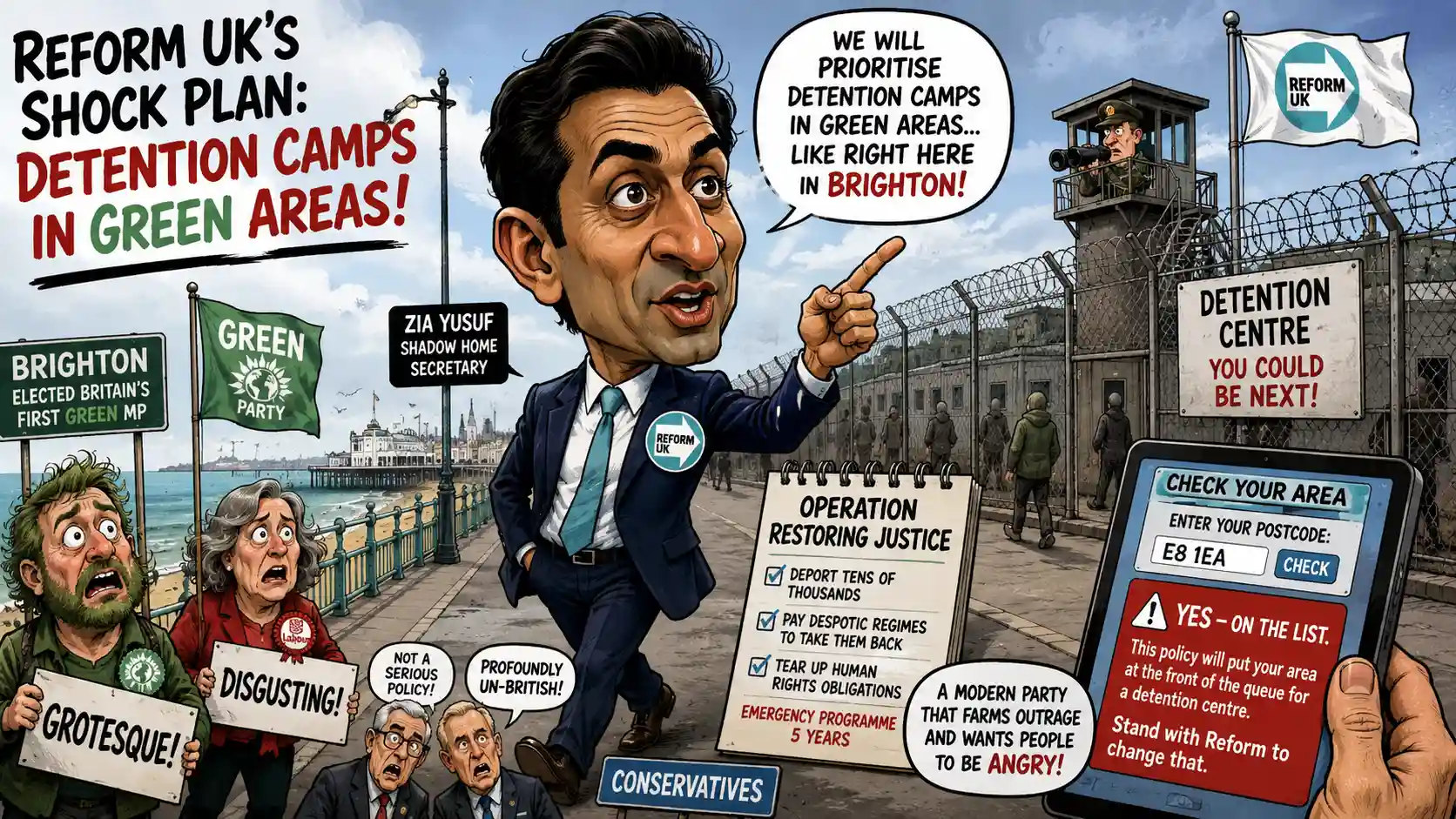
Why is Reform UK threatening migrant detention camps with Green zones?
‘Grotesque’ approach seen as an attempt to accentuate dividing lines ahead of local elections
It was certainly eye-catching, coming just days before millions head to the polls: Zia Yusuf said a Reform administration would “prioritise” siting migrant detention camps in districts with Green MPs or councils.
That means places like right here in Brighton,” said Reform’s shadow home secretary with barely concealed relish, in a video in which he paced the beachfront at the constituency that elected Britain’s first Green MP.
Along with the proposal, a webpage was launched for interested voters to enter their postcode to ‘check’ the polls to see if their area was likely to be the location of a detention camp. Type in E8 1EA — the postcode for Hackney town hall where the Greens are projected to win council elections this week – and a red box with an exclamation symbol appears with the warning: “Yes – on the list. This policy will put your area at the front of the queue for a detention centre. Stand with Reform to change that.
Cue condemnation from Reform’s opponents on the left and right. The Greens and Labour branded the idea as “disgusting” and “grotesque” while the Conservatives derided it as “not a serious policy” and one “made up on the spot for a social media video”. “It’s unworkable and profoundly un-British,” said Imran Hussain, director of external affairs at Refugee Council.
YouGov polling published on Tuesday revealed that 45% of the more than 4,000 individuals interviewed on the same day did not think it acceptable for a government to make choices that affect particular seats based on which party they supported at a general election.
37% of Reform Party voters thought such actions were undesirable, while 34% said it was acceptable to do so.
So what are the Reforms up to? On one level, a simple need to get attention on social media was certainly a factor. By Tuesday the video in Brighton had racked up 3.7m views on Yusuf’s X account. He, like Green leader Zack Polanski, does not have the relative benefits of a parliamentary podium.
But there also seems to be a wider agenda behind the policy, which appears to have been mostly made up in Yusuf’s own office, a product of a supposedly new party which Nigel Farage has defined as less the “one man band” of old.
As one insider puts it: “Zia’s office works in marvellous and mysterious ways.”
Above all there is the Reform wish to present itself and the Greens as the two real choices in front of the electorate this week, especially in English council elections.
“The failed uniparty era is over and it’s a battle for the soul of our country between Reform and the Greens,” said Yusuf, who has challenged Polanski to a live, head to head debate in the past but has been unsuccessful.
The proposal is aimed primarily at Reform’s base in places where the Greens are not likely to do well, such as former Labour heartlands in London and other cities.
“Reform are a very modern political party, which farms outrage and wants people to be angry, so in a low turnout election – as local elections are – this is about making sure their voters still have something to feel strongly about,” said John McTernan, a former political adviser to Tony Blair.
Reform are actually an authoritarian party and they say they want to deport tens of thousands of people because they really want to do it. This new policy is the linguistic flourish to get people talking about that policy.”
Last August, the central plank of Reform’s deportation policy was outlined in the launch of its “Operation Restoring Justice” document in which the party promised to deport hundreds of thousands of asylum seekers, pay despotic regimes such as the Taliban to take them back and tear up the UK’s postwar human rights commitments. The five-year “emergency programme” will detect, arrest and deport illegal immigrants.
What got less attention this week was the fact that Yusuf’s latest statement was a departure from that initial paper. Hackney, Lambeth or Brighton were not mentioned that time. Instead the party stated Secure Immigration Removal Centres (SIRCs) to detain up to 24,000 people would be created in “remote parts of the country”.
Was the turnaround also a product of focus grouped thinking from would-be voters? Who knows. The party definitely has the sort of war chest to fund such research.
But what must be overlooked is the battle for a not small number of voters considering a vote either for the Greens or Reform — parties which on paper are diametrically opposed but both appear as populist change-agents.
Green activists canvassing in regions where the party feels it is well placed to profit from a desire for change among voters have not missed Reform’s policy.
“It hasn’t come up when we knock on doors here and talk to people who are – quite obviously – much more concerned about bread and butter things,” said James Meadway, a former adviser to former Labour shadow chancellor John McDonnell, who is now standing to be a Green councillor in the Bromley North ward of Tower Hamlets council.
Meadway said Reform’s program was an effort to speak to its core voters, in essence. But he said: “The other thing we are seeing is that even where we are finding people who are conflicted between voting Reform or Green, or not voting at all. “They are folks who are mad about the way the world is and they want something to change.