

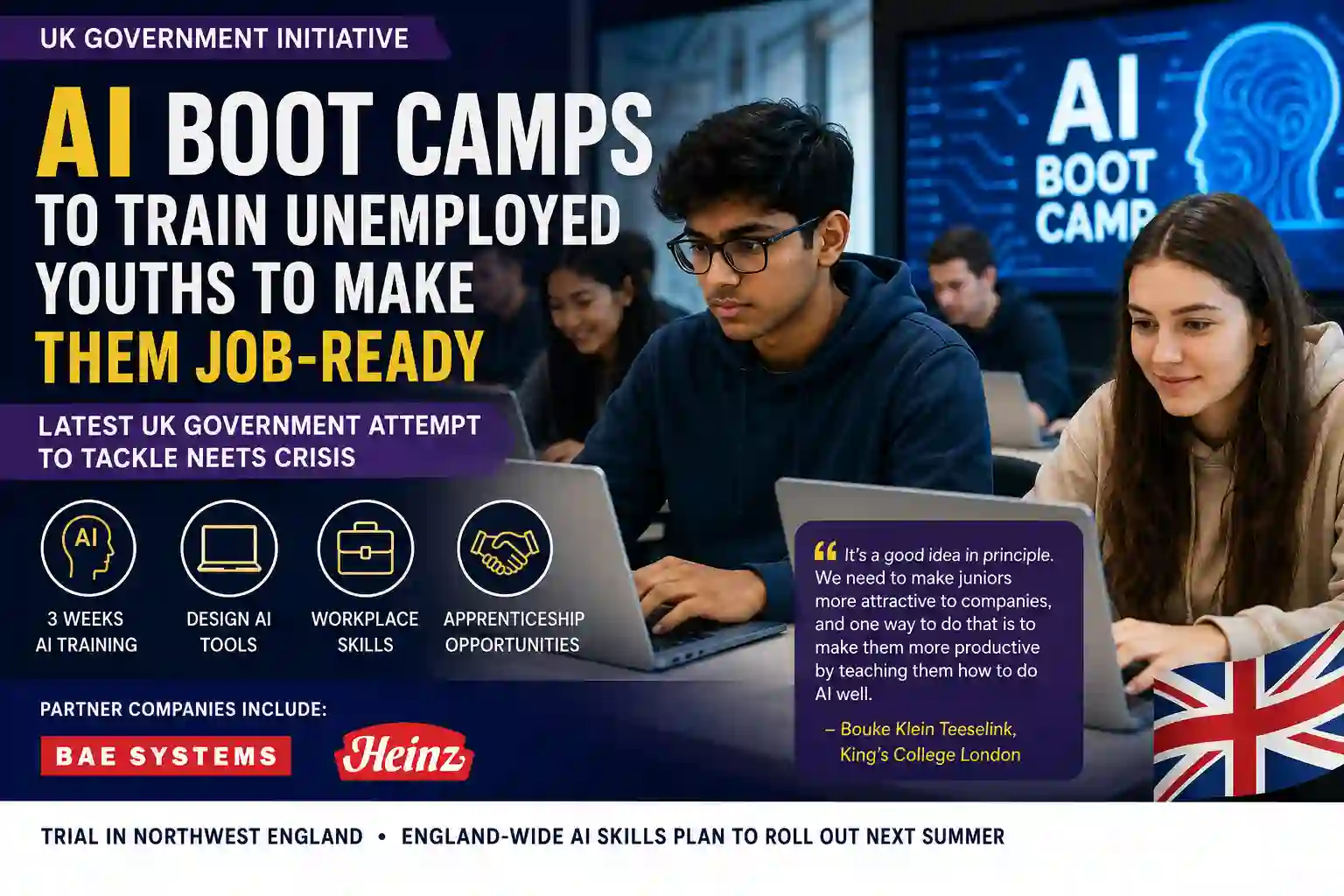
Latest UK government attempt to tackle Neets crisis: Pilot initiative offering three weeks of training
Young people out of job or at risk of unemployment in the UK will be put thru “AI boot camps” where they use the technology to get a foot in the door of the workplace.
The government is trying a new approach to solve the crisis in Neets (young people not in work or school) – by using a technology many see as a danger to jobs.
A trial in northwest England will provide up to 70 youngsters aged 16-21 three weeks of AI training including how to design AI tools, how businesses use AI and how to use the technology ethically. Training will also include workplace skills such as the use of office IT systems and timekeeping.
Most boot camp attendees are to be offered an apprenticeship with local companies that have signed up, including defence giant BAE Systems and food producer Heinz, the government said.
Digital, culture, media and sport minister Lisa Nandy said the program would “help young people at a vital point in their lives”. The trial will be used to develop an England-wide AI skills plan, to be rolled out next summer.
The boot program will leverage AI tools from U.S. tech companies, including Microsoft, ChatGPT creator OpenAI and Anthropic, the startup behind the Claude chatbot.
“It’s a good idea in principle,” said Bouke Klein Teeselink, a scholar at King’s College London and a specialist on the influence of AI on work.
“We need to make juniors more attractive to companies, and one way to do that is to make them more productive by teaching them how to do AI well,” he said.
But Teeselink said he was doubtful that a three-week program would be enough to get teens “AI-ready”, given AI readiness involved continual learning and updating abilities.
The influence of AI on jobs has been particularly focused on school leavers and graduates, with AI tools seen as capable of doing the “grunt work” usually done by newcomers to the workforce, with white-collar fields such as law, banking and marketing among the most vulnerable.
This week, Stanford University in the US reported a reduction in employment of young workers in AI-exposed industries such as software engineering and customer service.
Kanishka Narayan, the UK’s AI minister, said the program would provide young people “the skills they need to thrive in the AI workplace”, despite concerns of increased strain on youth employment.
The latest figures, published in May, revealed the number of young people aged 16 to 24 not working or in education or training (NEET) reached 1.01 million in the three months from January to March, the first time it has topped 1 million since 2013.
A report by former Labour minister Alan Milburn, also published in May, said the proportion may grow to one in six by 2031 and Britain risked creating a “lost generation” of young people ill-prepared for employment.
Andy Burnham last month vowed to limit the amount of Neets but would not put a date on it.