

Abstract
- Burnham promises to revamp social care system
- Social care costs have soared
- Burnham calls for cross party drive
- Past governments have been unable to agree on a proposal
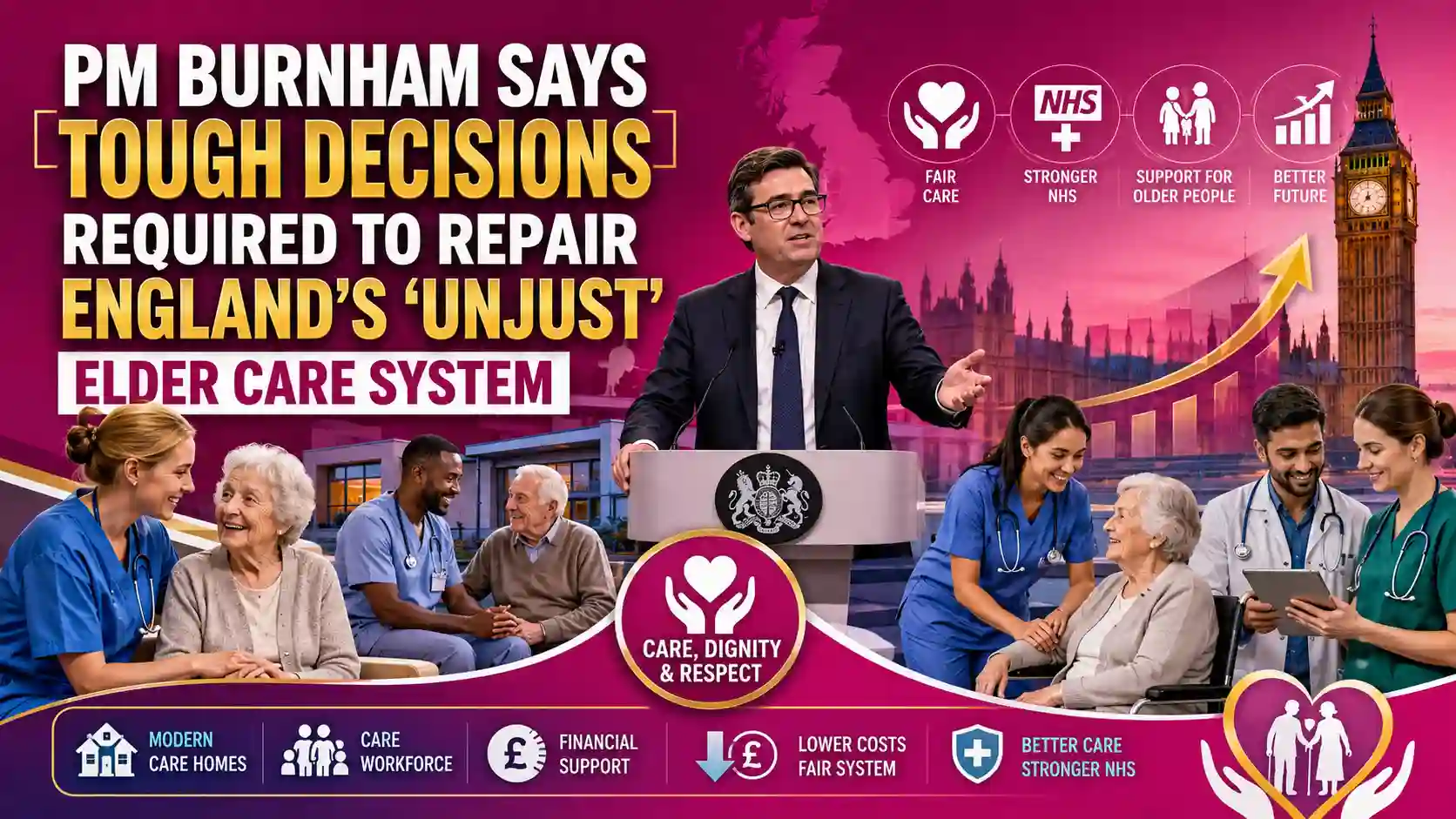
British Prime Minister Andy Burnham promised on Wednesday to make tough decisions to restructure England’s adult social care system, saying he wants to cooperate with other parties to stop unfair high costs for users he compared to U.S. healthcare.
Repeated attempts to reform adult social care have been blocked by opposition parties, who have labelled them a “dementia tax” or a “death tax” at a cost of hundreds of thousands of pounds for families.
Burnham did not rule out tax rises to create a new program and said that “scare stories” from media headlines would not put him off solving a crisis that will only get worse as the population ages.
“It’s a major dereliction of public duty that parliament hasn’t faced up to this,” he told an audience at a care home in north London.
Asked if he could improve social care without raising taxes, he said there was more that could be done within existing resources but some of the ideas “will require difficult decisions”.
“We will be straight with people about those,” he added, adding he will stick to a manifesto vow not to raise certain personal taxes.
Push for Overhaul Comes from Burnham’s Own Experience
Mr Burnham, whose father’s experience of Alzheimer’s is one reason he is motivated to improve the system and put right what he calls the “shameful” political record on care, has seen a rise in the poll ratings of the governing Labour Party since becoming prime minister last week.
“I think social care in England is as inequitable as American healthcare,” he remarked.
“The vulnerable pay with everything and it can leave them with nothing.”
He said he will speed up a study of the sector, draw up a care workforce strategy and talk with the opposition to address the issue.
The Conservative and Liberal Democrat parties will debate the subject, with a view to creating a national consensus.
Burnham said he was prepared to put political capital into overhauling the care system.
He had attempted and failed to restructure social care spending as health minister in 2010 and stated he had learned lessons from that incident.
The National Health Service is free at the point of use, but care homes are run by a variety of providers, from big chains controlled by international private equity corporations to smaller family-owned businesses, charities and local government.
He claimed a national care service integrated into the health service in England would ease the burdens on both.
Health and social care policy is a devolved matter to the governments in Scotland, Wales and Northern Ireland.
He also claimed he would target profiteering in the care sector, driven by wasteful and unsafe cost-cutting which he said was “fundamentally unacceptable”.
Locally, authorities pay approximately £1,000 for the same treatment, while a private resident pays roughly £1,400 ($1,900) a week, depending on the area and medical need.
The resident’s wealth level determines how much the resident pays and how much the state contributes.
Sarah Woolnough, chief executive of the King’s Fund health think-tank, said one in seven older people were now expected to pay more than £100,000 in lifetime care costs and there had been “a decades-long failure to act, with attempts to fix the system now lying in Westminster’s graveyard of good intentions.”
“This is the time to take advantage and show what social care can do to make people’s lives better, and take the strain of this broken system off the NHS,” she said.