

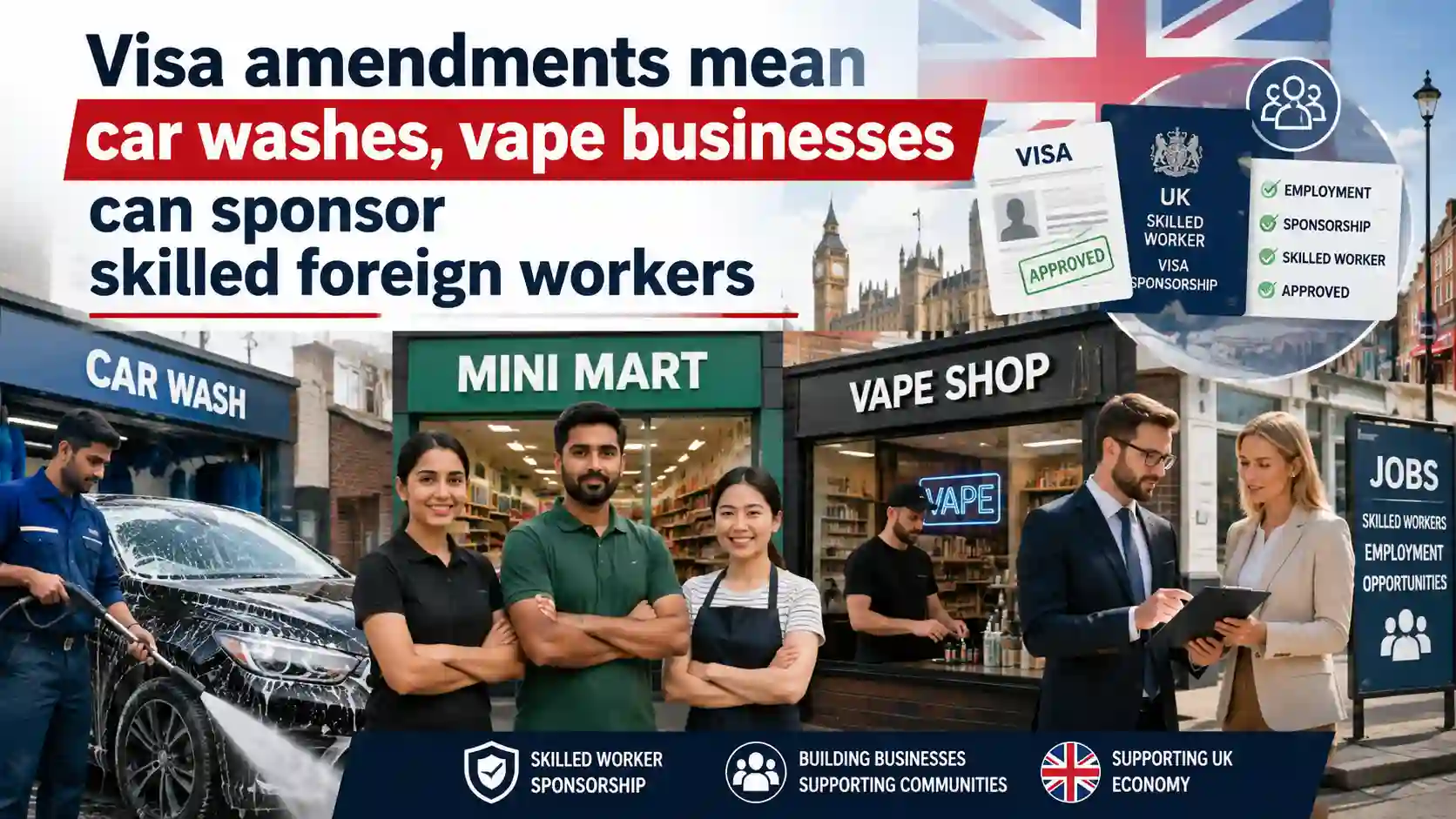
Visa amendments mean car washes, vape businesses can sponsor skilled foreign workers
Visa requirements and Skilled Worker Sponsorship
Visa requirements have been tightened but BBC Verify has revealed that more than 1,900 tiny high street businesses like mini-marts, vape shops and car washes are approved to sponsor foreign workers under a specific scheme, for high-earning individuals.
Under the Home Office initiative registered employers can bring staff in from overseas if they are of a specific competence level. In July 2025 the restrictions were amended to largely restrict the scheme to graduate level employes earning at least £41,700.
But a year on after the rule change BBC Verify has identified more than 1,500 grocery and convenience stores, 150 taxi operators, 100 barber shops and dozens of car washes and vape shops are still on the register and can sponsor people to apply for visas.
Rules were tightened, and over 100 of those companies added to the skilled worker sponsorship list. Being on the register does not indicate that an application for an individual visa will be approved.
Health Secretary Yvette Cooper said on Thursday that the government would “make sure that the rules are properly enforced because we can’t have employers getting round the rules or finding different ways to deviate”.
Home Office assessment of Skilled Worker Sponsorship
Home Secretary Shabana Mahmood two months ago ordered an urgent assessment of the existence of vape shops, barbers and car washes on the skilled worker sponsor registry following concerns over the “potential misuse of the system”. Any business trying to misuse the system would have its licence revoked, the Home Office said at the time.
“We have raised the skilled worker threshold and over 100 occupations are now ineligible for new skilled worker visas,” a Home Office official said.
Some of the companies who joined the register after the rules changed may have applied before the change came into force, it is understood. Some companies may also have stayed on the registry because they were approved before July 2025 or are sponsoring workers currently in the UK.
More than 120,000 businesses hold licences to sponsor skilled workers. The skilled worker plan was introduced after Brexit for firms to hire staff after the free movement of EU citizens ended. Smaller organisations have to pay a £611 cost to apply to join the register while larger businesses, such as those with more than 50 personnel, pay a price of £1,682. During the application procedure the UK Visas and Immigration service may visit anyone.
Skilled Worker Visa rule changes
Until last July, a foreign recruit might qualify for sponsorship if their qualifications were at an A-Level or equivalent quality, provided they were paid at least £38,700 in most situations. The rule change means non-graduate professions such as shop managers are no longer able to apply. There are also more demanding English language skills standards that came into effect in January this year.
The Home Office said there were 68,067 skilled worker visas issued in the 12 months to March this year – 29,745 to primary applicants and 38,322 to their dependants – which is a 30% drop on last year. IT experts were the most prevalent sort of persons to be given the visas, followed by those in finance, with the decline in approvals primarily owing to those in food preparation and hospitality trades no longer qualifying for the scheme.
The government has identified jobs like as sales and shop assistants and taxi drivers and chauffeurs as being ineligible for skilled worker visas, but there are some exemptions, such as for bricklayers, carpenters or nursing assistants and other occupations where there is a shortage in the UK.
Skilled Worker Sponsorship licences and enforcement
The Home Office cancelled 3,299 licences in 2025 compared to 347 in 2023. There is no record of how many sponsorship certificates or visas have been granted for each business or what type of role it has employed for. But Home Office guidelines says firms must offer genuine jobs that match skill and salary standards and only sponsor people for qualified roles.
Since companies are just mentioned by name, it is not often obvious what industry a company is in. BBC Verify matched their names and locations against Companies House records and Google business listings to see if the mini marts, car washes and other small operations were on the list, and analysed company names to identify the more than 1,900 small high-street businesses still holding a sponsorship licence.
Some 1,700 of them were in England, more than 140 in Scotland, over 80 in Wales and just two in Northern Ireland.
Separately, BBC Verify identified 60 businesses on the register that have been penalised for using unlawful workers between April 2024 and December 2025. They were fined a total of £2.5m.
“Illegal working will not be tolerated and businesses who receive two or more illegal working penalties of up to £60,000 or fail to pay a penalty first time will have their licence to hire workers revoked,” a Home Office official said.
Immigration experts on Skilled Worker Sponsorship
Dr Madeleine Sumption, director of the University of Oxford’s Migration Observatory, announced the modification to the visa requirement and stated if the enterprises were on the register before the rules changed, they can continue to employ persons they had already sponsored. “But they can’t bring in a new person now to do those jobs.”
Toby Way, a lawyer at WestBridge Business Immigration, which helps businesses seek to be sponsors, told BBC Verify: “Most sponsorship approvals are legitimate but we do see a lot of exaggeration and some outright lying about sponsored roles.”Hotels and restaurants have been badly damaged by the rule revisions. “They can’t sponsor a chef or a manager right now, but they might say they need someone for marketing or book-keeping, because those jobs are on the temporary shortage list,” he said.“We know the Home Office now considers the finances of the businesses and whether the revenue or profit means they can pay the required salary.
According to immigration lawyer Joanna Hunt at DAC Beachcroft, a high street shop would struggle to justify sponsorship at degree level.
With a few exceptions, a position will need to be skilled to ‘degree level’ for a business to be able to sponsor a worker to fill it and the Home Office will evaluate if the role fits with the type of business the sponsor runs. This might be difficult to show at a shop on the high street.”