


UK Care Worker Settlement Rules 2026: Major Five-Year ILR Exemption Revealed. Transitional procedures under the new settlement criteria mean that certain care workers and their dependants will still qualify for settlement after five years.
The Home Office is revising the criteria on when migrants living in the UK become eligible for permanent residence (also known as settlement or indefinite leave to remain/ILR). Many people currently living in the UK will now have to wait longer than they thought to qualify.
The normal qualifying time for those on work visas is now five years. This is being raised to ten years with possible reductions depending on the person’s work and income. This means that lesser paid employees have to wait at least ten years before they are established.
UK Care Worker Settlement Rules: Who Qualifies for the Five-Year ILR Exemption?
But there is a particular exemption for care workers, who the government considers a “unique cohort”. Some will still be able to apply for settlement after five years as they initially thought if they entered the care route before 12 May 2025 and have remained in sponsored work earning at least £25,000 a year. People in several other lower-paid healthcare jobs such as nurse auxiliaries will also be covered by a similar exemption.
The details of this exception have not yet been disclosed – for instance the immigration status the person ought to have had before the cut-off date or whether any time out of work or with lower earnings will be acceptable.
Those care workers who do not qualify to continue on their current five year path to settlement will instead be granted a special five year visa extension.
How Many Care Workers Have Arrived in the UK?
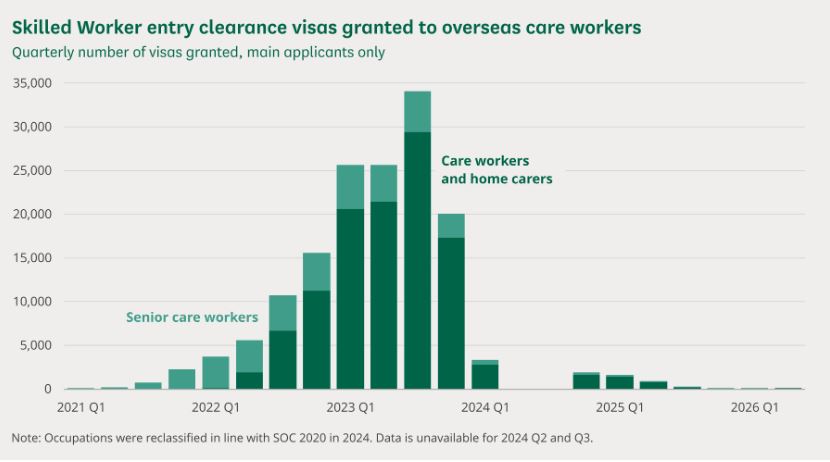
The number of care workers coming to the UK from overseas rose fast when ‘care workers and home caregivers’ were made eligible for Skilled Worker visas in February 2022. Since January 2021, ‘senior care workers’ have been on the list of roles eligible for work visa sponsorship, while entry-level care workers and home carers have been omitted.
Home Office data on sponsored work visas by occupation shows at least 152,000 Skilled Worker visas have been issued to overseas care workers since January 2021. We don’t have data for Q2 and Q3 2024 thus this number is likely to be higher.
The data below shows that the number of visas granted has climbed since the regulation change in February 2022, from about 36,000 in 2022 to 105,000 in 2023, before decreasing steeply.
The graph only shows those applying from abroad and not those already in the UK changing from other methods. There is no way of knowing from published figures just how many persons moved into the social care route at this time. But the government has indicated there were about 250,000 persons and their dependants that came on or switched into this route between 2022 and 2025.
How Did Government Policy React?
High levels of immigration in the years after the covid-19 epidemic were partly due to higher recruitment of overseas care workers (and arrival of their dependent family members).
In December 2023 the government announced modifications to the visa rules to try to reduce immigration during this period of high immigration. Social care providers have been unable to bring dependants on their visa since March 2024. But the number of visas granted to care workers had already began to plummet from the last quarter of 2023, before this adjustment. The government said the fall was due to ‘increased Home Office surveillance of employers in the health and social care sector, and compliance activity targeting migrant worker businesses’.
The 2025 immigration white paper halted overseas recruitment of social care professionals. Entry-level and elder care workers have been removed from the list of vocations eligible for sponsorship from overseas from July 2025.
How Many Care Workers Will Be Helped by the Transitional Arrangements?
Government predictions estimate that there are 196,000 care workers and 186,000 dependants due to come to the UK who may qualify for the transitional arrangements.
The government estimates that around 146,000 care workers and 136,000 dependants could achieve the eligibility conditions and hence remain eligible for settlement after five years. But it warns that these figures are uncertain. How many people will qualify will depend on the specific eligibility standards which have yet to be determined.
Under these assumptions an exclusion of 50,000 care workers and 50,000 dependants would apply. Instead they would receive a special five-year extension to their visas. They would not qualify automatically but would be able to apply for settlement after completion of the extension.
5,000 of their dependants and an estimated 6,000 people who become care workers after the immigration white paper was published. These people will not qualify for the transitional arrangements and will move onto the new regular 10-year road to settlement.
What Is the Fiscal Impact of Care Workers Coming to the UK?
In March 2026 the Home Office issued research estimated lifetime net fiscal expenses of care workers and their adult dependants likely to settle in the UK between 2026 and 2030. The net fiscal cost is the difference between taxes that people are expected to pay and the cost of the public services and benefits that people are expected to get in their lifetime.
Estimated Net Fiscal Effect Per Capita Throughout Lifetime
The Home Office figures rely on analysis from the Migration Advisory Committee (MAC) which is an independent public group that advises the government on migration problems.
Care workers arriving in the UK in 2022/23 were predicted by the MAC to have an average net lifetime fiscal contribution of -£36,000. The similar number for adult dependants on the Health and Care Worker visa route was -£67,000. A minus symbol implies a net cost.
The estimations take into account predicted tax payments and use of public services but do not incorporate broader economic implications. The MAC said its research had not taken into account “potentially important” positive benefits health and care workers may have on the larger population and the cost of delivering health and care services.
The graphic below shows the MAC’s estimates of the net lifetime budgetary impact of people arriving on chosen work and family visa routes in 2022/23.
Expected Cost of Settlement of Cohort of Care Workers and Adult Dependants
The Home Office has merged the MAC’s data with its own estimates of the number of care workers and adult dependants likely to arrive in the UK between 2026 and 2030. It predicted:
care workers arriving between 2026 and 2030 would cost £4.2 billion net over their lifetime adult dependants of care workers would cost £5.3 billion net over their lifespan
Adding these data together, the anticipated net lifetime cost for this cohort is £9.5 billion, rounded up by the Home Office to £10 billion.
The methodology employed settlement forecasts disclosed in the government’s original earned settlement consultation document. These estimated 189,000 main applicants and 274,000 dependants who came to the UK first on the Health and Care Worker visa route would settle between 2026 and 2030.
Visa data was used to estimate the number of these people who were care workers or adult dependants of care workers. The Home Office reported that 62% of Health and Care Worker visas were given to principal applicants in ‘caring personal services’ industries. This covers care workers, senior care workers and various other related jobs. It assumed that the same number of dependants had accompanied people working in these occupations. It estimated 47% of dependants were adults.
Applying these proportions to the settlement forecast, the Home Office anticipated that roughly 117,000 care workers and 79,000 adult dependants will settle between 2026 and 2030. It multiplied these statistics by the MAC’s estimates of the average net fiscal cost of care workers and adult dependants who arrived in 2022/23. This assumes the fiscal impact of arrivals in 2022/23 is reflective of the entire cohort predicted to settle between 2026 and 2030.
The settlement projections utilised in this calculation are based on different assumptions than more current modelling by the government. In the government’s answer to the earned settlement consultation, the updated predictions assume that 85% of Health and Care Worker visa holders will eventually settle in the UK whereas the earlier modelling assumed 67%. This reflects fresh evidence and shows the uncertainty around these forecasts.
Is the Government Going to Pay £10bn for Transitional Arrangements for Care Workers?
The £10 billion number is an estimate of the lifetime fiscal cost of the cohort who came to the UK on care worker visas and were expected to settle, not of the savings projected from the initial proposal by the government to extend the qualifying term for care workers.
As the Institute for Public Policy Research (IPPR) think tank points out, the original ideas would have postponed settlement, rather than stopped care workers and their dependants from settling completely.
The IPPR notes that by delaying settlement, there would be less spent on benefits (which most migrants on temporary visas are unable to receive) in the lengthier wait. But other expenditures, included in the £10 billion estimate, would still be incurred whenever people in this category did eventually settle. The assessment takes into account costs for the rest of people’s lives, including state pensions and greater usage of health and social care.
The government has not issued an updated estimate since the introduction of the transitional arrangements for care workers. But it has claimed it will carry out a detailed impact assessment and disclose it before the reforms are implemented.