

Summary
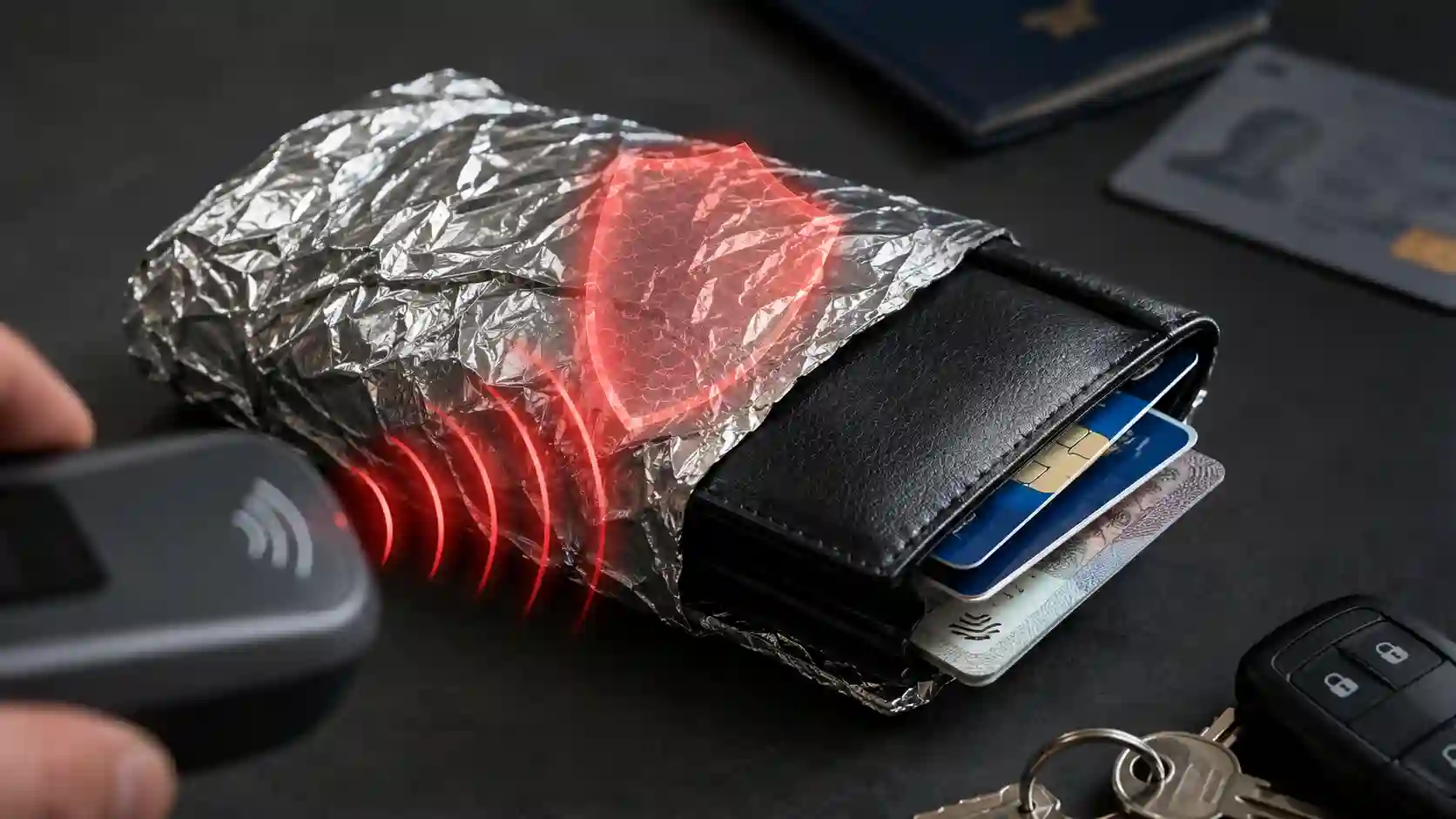
Wrapping wallet in aluminium foil: Many modern wallets include ID cards that may be read wirelessly. These chips can send unique ID numbers across considerable distances. Aluminium foil can be a fundamental barrier to these radio waves. The increased hazards for the transmission of data to the enhanced driver’s license and the passport card. Securing your wallet as a whole is a sensible security practice.
Scroll through TikTok for long enough and you might spot it: someone wrapping their wallet in a piece of kitchen foil as if it were a burrito. That sounds like a joke until you see what is actually resting inside most American wallets. It’s more than a credit card. The ACLU of Washington says the unique ID number on an Enhanced Driver’s License can be read by standard commercial RFID readers from 162 feet away, that’s the width of a football pitch. “This is a documented concern from a civil liberties group that advocated for state laws that limited this kind of scanning. So before you dismiss the foil trend as paranoid, it’s helpful to know exactly what is being transmitted and from where.
Wireless Theft Is a Major Problem
Many of the things we touch today have contactless chips in them. RFID or NFC technology is used to make things work swiftly at checkpoints, turnstiles and doors – from government IDs to transport passes and workplace credentials. That convenience is real, and so is the tradeoff. According to the ACLU, RFID tags on Enhanced Driver’s Licenses were flagged as insecure, with the addition that DHS itself had acknowledged the chips could be read from as far as 30 feet away. The ACLU cites a security researcher who assembled a reader from about $250 in spare parts and drove around downtown San Francisco to show the cards could be skimmed and copied without the owner noticing. It also contends the licenses lack fundamental security features seen on U.S. passports and smart chip credit cards.
To be clear, this is not the same thing as someone emptying a bank account from the other side of a tube platform. Most of these chips have a reference number, not your personal details, and they usually require equipment that most people will never see. The main fear is not of a spectacular one-off robbery but of quiet recurrent tracking. The chip can send out the same set number everywhere a person walks.
Does Foil Really Work?
This is the basic physics. Aluminium is a conductor. Conductors impede or scatter radio waves. It’s the same idea that applies to a Faraday cage, a sealed metal container that inhibits signals from getting in or out. “The metals in RFID-blocking wallets, like copper or aluminium, block the RFID radio signals that are emitted, but don’t damage the card or document itself,” says Norton.
But it’s not without its problems. Aluminium foil works rather well at blocking RFID tags, but it splits quickly and has thin areas that can let some signal through, thus a few tight layers are better than one loose wrap. It works best if it covers the complete wallet, which is especially important since that wallets often include numerous wirelessly readable objects, not just one card.
But experts also emphasise that this may not be a foolproof plan. There are fine points that need to be right for this strategy to be highly effective. For instance, if the coverage is perfect, with no cracks or tears, no signal will get through. Moreover, the efficiency of this technique will depend on the frequency and type of the chip employed. So wrapping in aluminium foil is viewed as a quick and cheap restrainer but not as a flawless security solution. Cybersecurity specialists advocate RFID-blocking sleeves or specifically constructed wallets. The inclusion of conductive material in the manufacture of these devices provides a more reliable deterrence. Also, these speciality items give durability with convenience while also giving a safeguard against unauthorised scanning.
Your Driver’s License Could Be One of Them
Enhanced Driver’s Licenses are accessible in only five states: Washington, Michigan, Minnesota, New York and Vermont. They permit inhabitants to cross land and sea borders to Canada and Mexico, and to arrive by sea from Bermuda and the Caribbean, without a passport, with a long-range RFID chip that border inspectors may read before a driver ever gets to the checkpoint. The Department of Homeland Security says no personally identifying information is saved on the chip itself, just a unique ID number tied to a secure federal database.
That has not completely allayed the anxiety. Privacy advocates continue to ask for stronger precautions because an EDL’s identification number is still readable at two feet away, even within the protective foil cover the card arrives with.
Your Passport Card Is an Even Larger Signal
You have a bigger risk with a passport card than with a regular passport book. AFAR reports that a radio-frequency reader for passport cards has a significantly greater range than a standard contactless card, and can scan the passport from as far away as 25 feet. That’s why the State Department puts every passport card in its own sleeve. Take the sleeve off and the card is essentially transmitting from the other side of a room.
Transit Passes and Work Badges Also Apply
The same underlying technology is used for reloadable transport cards, and most office or campus access badges. They are not generally stolen like a payment card because they have no immediate value. But they are, in effect, wireless-readable things in the same wallet, so the same shielding logic applies to them as it would a licence or passport card.
The Greatest Change in Habits
The point is not really about the foil, as such. It’s just that the average American wallet today holds more wirelessly readable objects than most people realise: a licence, a passport card, a transit pass, a badge, credit cards, occasionally all five. Thinking of the wallet as one unit worth preserving is a more practical approach to think about the problem than worrying about a single card. If foil sounds like too much of a headache, a Faraday sleeve or RFID-blocking wallet offers the same coverage and is built to last longer.