

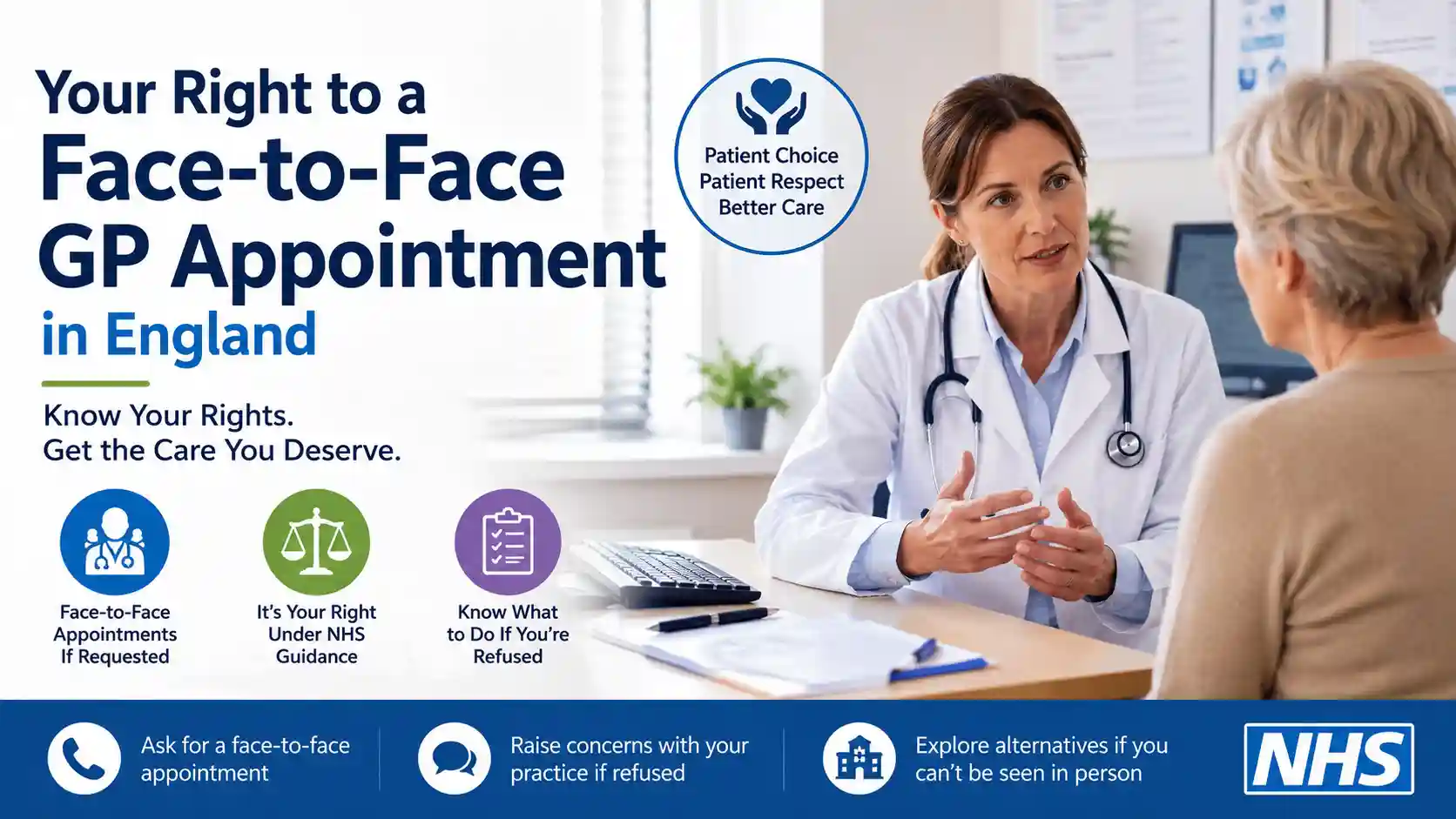
Your entitlement to a face-to-face GP appointment right if you are not offered one
NHS guidance states that GP practices in England should offer face-to-face appointments if requested by patients
GPs have to provide patients with a face-to-face visit if they want one. NHS GP says: ‘Practices in England have to provide face-to-face visits if people want them “GPs who do not make the necessary arrangements for patients to make an appointment without having to spend hours on the phone or who are not available for face-to-face appointments are, in the strictest terms, breaking the law.”
NHS England has released guidance to GP surgeries clarifying practices have a duty to ensure they deliver in person consultations and should respect patients’ wishes for face-to-face care unless there are valid clinical reasons not to, such as if a patient is experiencing COVID symptoms.
Guidance from NHS England says GP surgeries should provide face-to-face appointments if requested, but there is no legal right to a face-to-face consultation if the GP feels a distant assessment is more appropriate. If you need to you can see a healthcare expert within 48 hours, but you don’t have to.
Sophie McGarry, solicitor and senior litigation officer at Fletchers Group, explains your legal rights to a face-to-face GP appointment. She also explained what you may do if you think you have been misdiagnosed during a telephone or video GP session.
If you feel you need to see someone in person, McGarry says, ask for it and tell us why. If they refuse, you can protest to the practice manager or submit an official complaint, according to the Liverpool Echo.
If an appointment in person is not available, what can you do?
In a letter to GP surgeries dated May 13, 2021, NHS England said that as a minimum, clear instructions should be placed on all practice websites and updated periodically and should include:
- How to get in touch with the GP and ask for help.
- face-to-face or walk-in access to services
Your first approach, says McGarry, is to check your surgery’s website to see if there is any information about how to obtain face-to-face or walk-in services. If you cannot find information on the practice’s website you can ask the practice to supply it.
She also says if you get any resistance from the surgery you can direct them to the letter from NHS England which says that this information should be published on their website as normal. Ask your GP Practice to book a face-to-face appointment for an assessment, examination or test and explain why you think a face-to-face meeting is needed.
You may also take them to the guidance from NHS England – which is clear that GP Practices have to offer face to face appointments, and surgeries should respect patients’ wishes to be seen in person. If the GPs or receptionists continue to refuse to see you face-to-face you can escalate the problem to the Practice Manager and ask them to explain why your wish and request for a face-to-face examination is being refused’, she said. You can see what alternatives are available to NHS patients now, in the NHS Choice Framework.
How can I book an appointment with a GP?
NHS GP believes it is quicker and easier to use an online form than spend hours attempting to get through to the reception at your local GP clinic by phone. Some practices list them on their GP surgery website, or you may be able to get them through the NHS app.
There are quite a few questions to answer on these forms, however this is often a far faster approach to get the GP services that you need than arranging an appointment over the phone. NHS GP adds: “These online forms are secure and confidential and can be used to contact your general practice about your own health or someone else’s – your loved ones in care homes needing health care services don’t need to add the stress of using online methods like this on top of their health conditions, so take care of this for them.If you or your loved one is happy to have an appointment online, this is usually considerably quicker to arrange and you can easily acquire one with NHS GP facilities. If you need help making an online consultation with your GP please get in touch here and we will do our utmost to help you get the healthcare advice you need.”
Book, change or cancel appointment
If you need to book an appointment with your GP surgery you can get in touch with them:
utilising a form on your GP surgery’s website (many surgeries also have a form you may use if you use the NHS App or log into your account on the NHS website)
- by phone in person by calling in to the surgery and talking to the receptionist
When you arrange an appointment your GP surgery may ask about your medical needs. This means they can assess the urgency of your issue and locate the best appropriate doctor, nurse or other healthcare expert to see you.
‘Better’ is a personal appointment?
“Telephone and remote assessments have their place for certain minor issues but overall I believe in-person appointments are safer and you are less likely to be misdiagnosed than if you had a remote assessment.”“There is no opportunity for a GP to do any tests or examinations if they are assessing someone over the phone. “Where a GP is seeing someone face-to-face, even if they are merely doing the checks as a precaution, this is more likely to pick up an anomaly than a telephone session.An in-person consultation also allows for any incidental findings which would not be picked up during a telephone examination. “In a remote assessment the GP is totally dependent on asking the right questions and the patient giving the right answers.
She said: “People are also talking about hard and sensitive personal issues. They may find it easier to open up to a GP in a face-to-face appointment, when they are receiving human, hands-on care, which is far more personable, than talking to a voice asking questions on the phone. “Remote consultations can make patients believe there is a disconnection from their GP and that there is less ‘care’. In stressful and emotional situations, patients will take comfort from the physical presence and human touch of the GP.When they come to a face-to-face visit, patients see a GP in the room and focus fully on the session and talking about their issues. Telephone GP appointments might catch patients when they are at work, travelling or doing the shopping, so the patient may not be able to give the session their complete, undivided attention.”
Some people may find it harder to judge distant consultations.
The counsel said: “Generally speaking, youngsters, the elderly and persons with mental health issues or communication difficulties can be harder to assess remotely. Children may have difficulty describing their symptoms, and may need to be assessed more carefully.The elderly may be hard of hearing and find it difficult hearing on the phone and may consequently be less able or likely to give a thorough account of their symptoms. They may also be less internet savvy and unable to share photos to show concerns. “I think older people value the face-to-face and human touch more. “GPs are more likely to find incidental findings, conditions and symptoms in older people in an in-person appointment.Some people may not be comfortable talking on the phone and may have a hard time expressing themselves, or may need to have an in-person visit in order to feel comfortable opening up about their mental health problems. “But it’s important to remember that all demographics are susceptible to health problems, which can be hard to assess remotely.”
You know what?
In most cases, if your GP refers you for treatment for a physical or mental health illness, you have a legal right to pick which hospital or service you want to go to. Many private hospitals are included, as long as they are delivering NHS services and the cost to the NHS is no more than a normal NHS hospital referral.
You can also choose a clinical team lead by a consultant or a named healthcare professional if that team can offer the treatment you need. More information is available on choosing a hospital or consultant and choosing a mental health service.
You can make appointments using the NHS e-Referral Service. You can do this at your GP appointment or alternatively online with the shortlist of hospitals or services in your referral letter. Your GP draws up this selection therefore it’s important to make your views known at your session. If you are waiting longer than the maximum waiting period for your treatment, you have the legal right to ask for your appointment to be transferred to another provider.
The hospital or integrated care board (ICB) will then have to investigate this and be able to provide you with a list of acceptable alternative hospitals or clinics that are able to treat you sooner. For further information please refer to the waiting times guide.
Does it make it harder to diagnose diseases when appointments are remote?”
“When consultations are done remotely, it’s much more difficult to accurately assess and diagnose any condition that requires visual examination or physical contact,” notes McGarry. This includes infection, chest and abdominal pain. It is important that patients can show their GP precisely where they are uncomfortable and the GP can push and feel the region to determine the precise cause of the pain.
“It is important to feel and see any lump to know its location, size, texture (firm or soft) and if it is tender to the touch,” the legal expert adds. The solicitor continues and emphasises that the comparison of the appearance and feel of the damaged portion to the healthy section of the body is important.
Cancer early detection standards are not based on images but on understanding your own body, doing self-exams and remaining attentive to any changes. Doctors have to feel the lump to see if it looks concerning enough to investigate further, or refer to a specialist, and if that referral should be routine or fast-tracked through the urgent two-week suspected cancer pathway.
McGarry said: “Examples include a digital rectal examination to help diagnose prostate cancer, or vaginal examinations with a speculum to visualise cervical abnormalities to help diagnose cervical cancer. GPs need to examine and feel the prostate or cervix to check if there are any questionable features that may need further investigation / further referral. “They need to consider what the referral should be based on, routine or an urgent two week suspected cancer pathway.”
NHS England says: “We should not be encouraging patients to send us clinical images of intimate areas, or to expose or self-examine intimate areas during a remote consultation. The GMC are clear that a chaperone should be offered to all patients. “Patients who need an intimate examination should, therefore, be encouraged to come in for face-to-face assessment.
If you believe that you have been misdiagnosed by telephone or during a video consultation, you should:
McGarry says: “If you believe you have been misdiagnosed over the phone or in a video consultation, at the time of your assessment, you are entitled to ask your GP to make a face-to-face appointment for further assessment, examination or testing and explain why you feel a face-to-face appointment is necessary.If that particular GP does not arrange an in-person appointment with you, you can call the surgery to make a further appointment and request an in-person appointment for a second opinion and further assessment, examination or testing and explain the reason you feel a face to face appointment is necessary.For example you could advise that you are very concerned that the lump you have located is suspicious and you feel a physical appointment is necessary so that the GP can see and feel a lump to decipher whether or not it is suspicious and needs further investigation / onwards referral and on what basis that referral should be made. If the GPs still refuse to see you face-to-face you could ask the Practice Manager to take the matter up.
If you feel your condition is urgent or worsens after a telephone or video consultation, it is important that you seek the appropriate medical care by attending a walk in centre, urgent care centre or A&E appropriate to the severity of your condition and your degree of concern about your symptoms.