

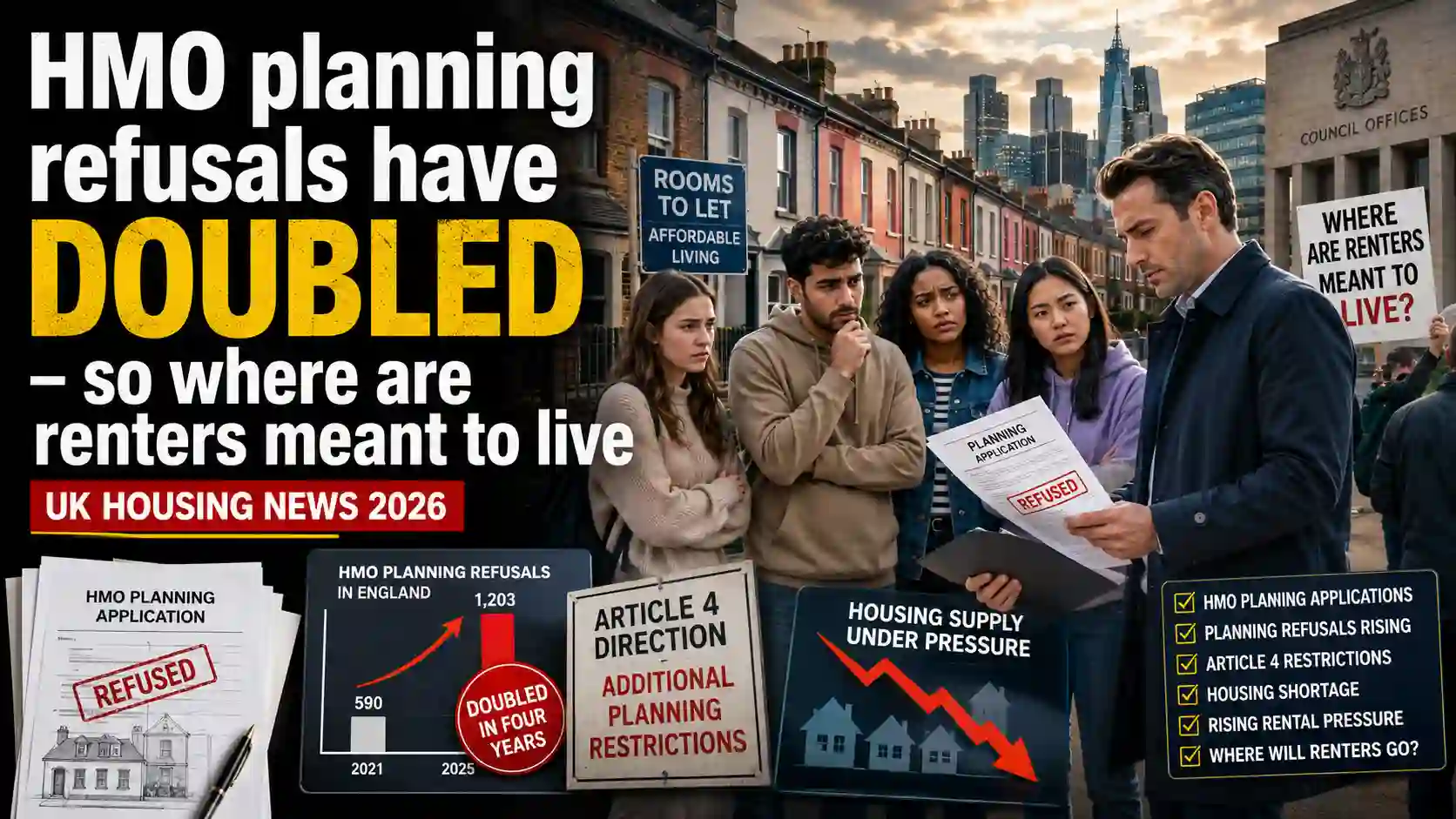
HMO Planning Refusals in England
In 2025, councils declined 1,203 HMO planning applications. The figure was 590 in 2021.
There is one major caveat. There was also a substantial increase in the number of decisions on applications, from 1,848 to 3,454 among the same 144 English councils. So authorities haven’t suddenly become twice as likely to decline an HMO application. The approval rating declined to 65.2% from 68.1%.
In practice, however, 613 more HMO applications were declined in 2025 than four years earlier.
Those refusals didn’t make the folks looking for affordable lodgings go away. They just made it against the law to furnish any more of such rooms.
That is the part of the tale that councils rarely seem prepared to tackle.
An HMO is a residence for someone
HMO is one of those words that sets the alarm bells ringing at local council meetings.
We hear about noise, garbage, parking, overpopulation and the loss of family homes. Some of those fears will be entirely valid. Badly conceived HMOs should not be approved and badly managed HMOs should be let to remain.
But not all HMOs are a poky house controlled by a nasty landlord.
A good HMO, well constructed and professionally managed, can provide excellent accommodation for persons who cannot afford, or do not want, a whole flat to themselves. This covers students, young professionals, important workers, persons moving for job, splitting couples and people simply attempting to get back on their feet.
Many of them don’t have a choice between an HMO room and a big one-bedroom flat.
It’s either an HMO room, an unaffordable flat, a long commute, somebody’s sofa or whatever informal arrangement they can find.
Councils can decline the planning application but they cannot legislate demand out of existence.
Article 4 is modifying the business calculation
In many areas of England, authorised development rights allow a change of use from a conventional C3 home to a modest C4 HMO for three to six unrelated occupiers.
That right is removed in the area subject to an Article 4 Direction. The landlord then has to submit a comprehensive planning application and risk their chances against the council’s local HMO laws.
This is hardly a total ban, at least not on paper.
In fact, some councils set concentration limitations which make it very difficult to get a permission once an arbitrary percentage has already been achieved on a street or within a defined radius.
A six good quality room HMO, nicely built, can be allowed on one side of an imaginary boundary but not on the other because, apparently, a municipal spreadsheet indicates there are already too many.
Of course, the tenants who may have occupied those rooms still had to live somewhere, but that does not seem to be a very big part of the calculus.
Article 4 Directions were designed to enable councils to cope with local concerns, shown. Increasingly we are seeing them deployed across quite wide regions, perhaps a whole town or boro.
That may be administratively convenient, but convenience and effective housing policy are not the same thing.
If the problem is isolated on a few streets, focus on those streets. Don’t make it harder to create legal shared housing everywhere and then be surprised when rents go up or people end themselves in less appropriate lodgings.
Landlords cannot afford to buy first and then research
This has made due diligence a critical part of the business evaluation, from the landlord’s standpoint.
You can’t just find a big property, work out room rents, get a quote for the restoration and trust the numbers work.
“Buyers should know prior to exchange of contracts whether the property is already within an Article 4 area and whether a new direction has been proposed and what the council’s local HMO policies actually are.
They will also need to confirm the existing authorised planning use of the property.
This is particularly crucial if a house is being sold as an existing HMO. A licence is not planning authorisation and just because tenants have been in the building for a number of years does not mean the owner can automatically justify the lawful use of the property when challenged.
As I outlined in When is an HMO not an HMO? , the problem generally arises when the landlord attempts to sell or refinance.
The buyer’s counsel requires proof of permitted HMO use. The lender has the same question. Suddenly everyone finds the licence, council tax records and old letting advertising don’t necessarily provide them the certainty they expected.
A landlord who can demonstrate that the property was legitimately utilised as a C4 HMO prior to an Article 4 Direction coming into force may be in a completely different position to someone seeking to create a new HMO now.
That difference can effect the property’s value, mortgageability and salability.
Restrictions may increase the price of current legal HMOs
There are clear business consequences when councils restrict new supply.
Existing legal HMOs might be more valuable as competitors cannot readily make more. Demand for rooms is high but the planning system limits how many additional rooms can be brought to market.
That can produce scarcity value, but only in respect of the property’s planning and licensing status being clear and proved.
A HMO with a planning history, properly licensed, sensible management files and evidence of continued occupation can be an increasingly valued asset.
An HMO bought on assumptions, with missing data and uncertainty regarding lawful use, might become an expensive problem.
And that is why landlords should not see planning as just something for the solicitor to look at just before completion. The planning position should be researched before the purchase price is agreed, as it has a direct bearing on what the property can generate and what it may ultimately be worth.
Say NO to the bad HMOs not the folks who need them
Nobody is saying authorities should approve all HMO applications.
Any conversion that would produce an unsafe layout, lack of facilities, unreasonable overcrowding or actual injury to neighbours should be refused. Rogue landlords should also be strongly enforced.
But that is hardly an argument for seeing shared housing itself as the problem.
There is a lack of affordable housing in Britain. Self-contained rents are becoming unaffordable for more and more people, social housing waiting lists are huge and municipalities are already spending huge amounts on temporary accommodation.
In that context, making it harder to provide professionally managed shared housing feels less like joined-up policy and more like one department transferring the buck to another.
An HMO can be rejected by a planning committee. It cannot vote out the renter that would have resided there.
Don’t allow the improper conversions. Prosecute the scoundrels. But let’s stop claiming that to deny authorised HMO accommodation is fixing a housing need.
The tenants still have to live somewhere.