

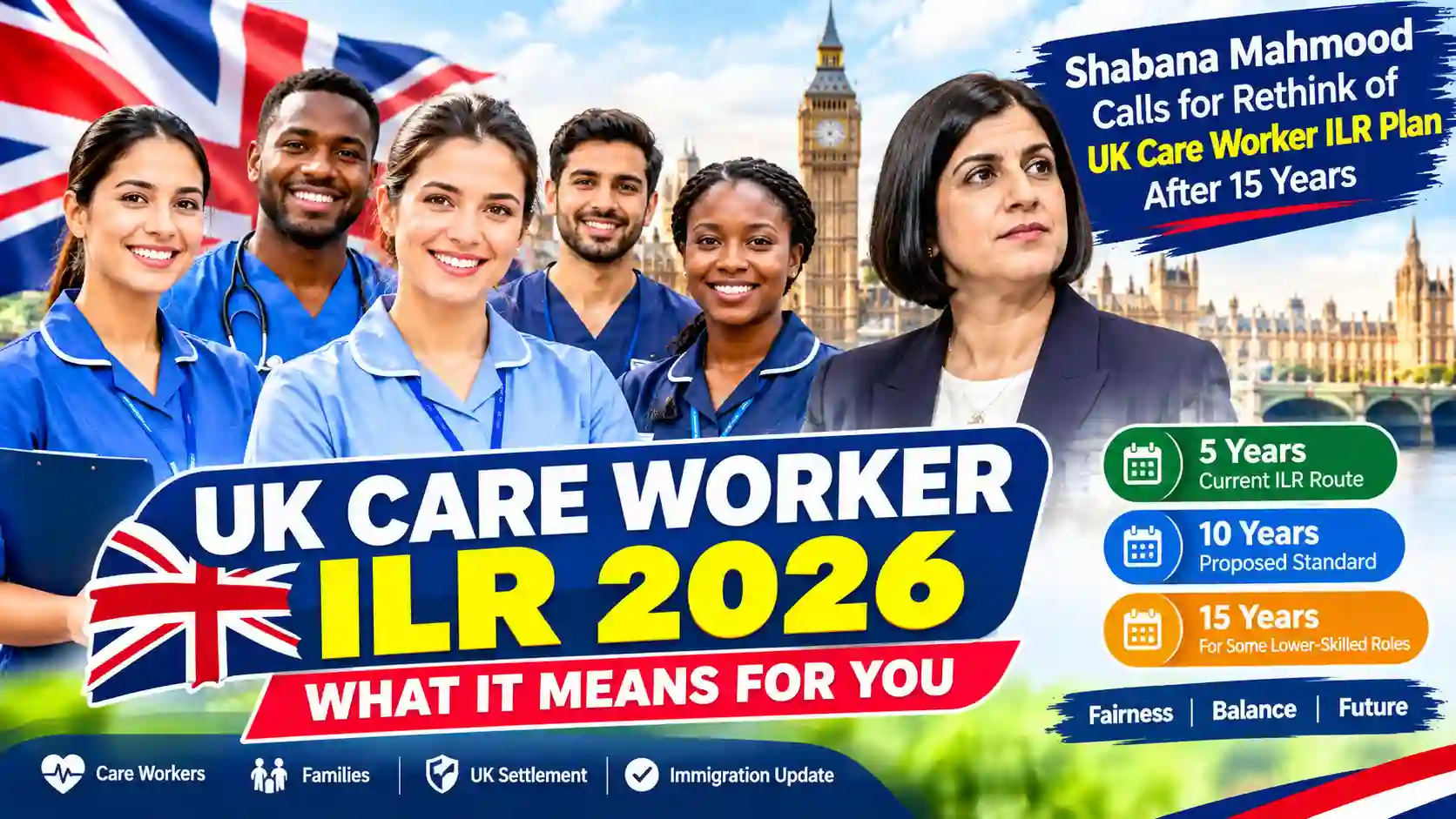
UK Care Worker ILR 2026: UK Home Secretary Shabana Mahmood has indicated the government may revisit controversial plans that may see some overseas care workers wait 15 years to qualify for permanent residence in the UK. There has been increasing pressure from inside Labour and trade unions.
Speaking at the Labour Party Conference in Liverpool on 28 September 2026, Mahmood said concerns about the fairness of parts of the government’s proposed “earned settlement” system had been raised and that ministers would strike a balance between people who had migrated to Britain legally and the interests of British citizens.
The development could be particularly crucial for the thousands of Health and Care Worker visa holders who came to Britain under the impression that, if they continued to meet the appropriate standards, they could potentially apply for Indefinite Leave to Remain (ILR) after five years.
But migrants should not read too much into Mahmood’s statements as a U-turn in the making.
No new settlement standards have been revealed and the suggested 15-year qualifying time for some lower-skilled workers has not become law.
The government is still evaluating how its wider earned-settlement changes should work and if people currently living in Britain should have transitional protection in particular.
Mahmood Acknowledges Fairness Issues
Mahmood used her speech to the Labour conference to defend the premise of changing legal migration, but admitted that some of the suggestions were open to criticism.
The government intended settlement to be earned by migrants who showed a sustained commitment to Britain, she told the conference, but understood that concerns had been voiced during consultation.
The administration would get to a position that was fair to individuals who came here legitimately and fair to British nationals, Mahmood added.
The BBC said the statements indicated Mahmood was willing to reconsider portions of the plan after pressure from Labour MPs, trade unions and Housing Secretary Angela Rayner.
The Guardian also claimed that Mahmood was willing to dilute several elements of the proposed settlement amendments, with international care workers being especially contentious.
But the Home Secretary did not reveal what the final qualifying term for care workers will be.
That’s an essential line. The government is looking into the technicalities and has not yet released alternative Immigration Rules that would give care workers a new settlement timeframe.
What Is the UK Care Worker ILR Rule Now?
A person on the Health and Care Worker path may be eligible to apply for permanent settlement after five qualifying years in the UK, assuming they meet all the other conditions for ILR, under the guidelines now available on GOV.UK.
Official guidelines for the Skilled Worker and Health and Care Worker route says that an applicant usually has to have spent five years in Britain before asking for indefinite permission to remain.
So don’t confuse the current five-year scheme with the government’s planned earned-settlement approach.
Current and proposed settlement periods:
- 5 years: Current possible ILR route for eligible Health and Care Worker visa holders.
- 10 years: Suggested standard baseline under earned-settlement reform.
- 15 years: Suggested baseline for some workers in vocations below RQF Level 6, which could include care workers and senior care workers.
The 10 and 15 year terms are suggestions being explored as part of the reform program and are not the present general settlement standards that apply to care workers.
How Did the 15-Year UK Care Worker ILR Plan Start?
The Home Office publicly issued its consultation on “A Fairer Pathway to Settlement” in November 2024.
It suggested switching to a system where a large number of migrants would qualify for settlement after a specified five-year period.
Instead, the government put up a “earned settlement” model, which would have a standard beginning point of 10 years, and the qualifying time may be either shortened or lengthened based on variables including contribution, integration and immigration history.
For workers sponsored in jobs below RQF Level 6 (about below graduate level), the consultation went further. It explicitly deliberated on a 15 year baseline qualifying period for this cohort.
The Home Office highlighted care workers since many people arriving through the Health and Care route in recent years have taken jobs below RQF Level 6.
According to official numbers quoted in the consultation, roughly 75% of Skilled Worker visas on the Health and Care route in 2023 were awarded for vocations below RQF Level 6 compared with 11% in 2021. This is why the settlement issue is especially critical for care workers.
What About Care Workers Already Living in the UK?
This might be the most critical concern for the existing migrants. The government’s consultation expressly notes that a new earned settlement system, without transitional arrangements, could affect those now on a settlement pathway but not yet holding ILR at the point the relevant new Immigration Rules come into force.
The Home Office enquired if transitional provisions should be made to reduce the burden on those currently in Britain.
There is no ultimate transitional system confirmed so far. That means that someone who came as a care worker expecting a five-year route should not yet assume either outcome:
They should not think they will surely be compelled to wait 15 years, but they should not expect that everyone already in Britain will automatically remain protected under the existing five-year regulations. This is exactly the element of the policy which is still politically problematic.
For example, a worker arriving in 2022 and approaching the existing five year mark in 2027 may be affected by transitional arrangements as to whether the worker can continue toward settlement under the current system or be subject to some type of altered qualifying period.
That is a question to be determined until the government publishes the final policy and associated Immigration Rules.
Why Are Care Workers the Focus of the Debate?
The number of persons arriving in Britain via the Health and Care route surged after care professionals and senior care workers became eligible for the route in February 2022.
Figures from the Home Office quoted in the earned-settlement consultation show around 616,000 persons were given Health and Care entry-clearance visas between 2022 and 2024 (including main applicants and dependants).
The Home Office forecasts that the Health and Care cohort might produce about 384,000 extra settlement applications from 2027 to 2029 given past settlement behaviour, with a high of roughly 210,000 in 2028.
Fiscal and migration reasons have been given by the administration for stricter settlement measures.
The Home Office research published in March 2026 predicted a cumulative lifetime net fiscal cost of roughly £9.5 billion (rounded to £10 billion) for care workers and their adult dependants expected to settle between 2026 and 2030, based on the assumptions used in that analysis.
The projections are part of the government’s policy case but critics of the proposed 15-year method say existing care workers were subject to laws that gave them a much shorter road to settlement, legally.
Labour and Unions Apply Pressure Over Care Worker ILR
The settlement plan has received considerable political opposition. Trade unions and Angela Rayner have been among those calling for adjustments, especially over the impact on international care workers already helping run Britain’s social-care system, the BBC and Guardian have reported.
Prime Minister Andy Burnham said the administration had to strike the right balance and that there had been a range of views expressed through the consultation process ahead of Mahmood’s speech.
The discussion now seems to be not just about whether limits on settlement will get stricter, but how tough and whether any existing migrants will be safeguarded from the changes.
Mahmood’s statements at the conference indicate those concerns are being factored into the final policy, which is being drafted. But they do not provide a full retreat from the 15-year plan.
Recruitment of Care Workers Has Already Been Tightened Up
The argument over compensation comes on top of a number of major restrictions previously imposed on the care-worker path.
From 22 July 2025, companies cannot directly sponsor new care workers and senior care workers from overseas on the route.
Some people who have already settled in Britain will have until July 2028 to switch into qualifying care roles subject to the relevant conditions, and there remains a continued window of opportunity for them.
Earlier, in March 2024, restrictions were implemented on care workers bringing dependants, while exceptions continue for some workers already on the route regularly before the change.
The settlement idea is therefore part of a much bigger reshaping of the UK’s attitude to lower-paid sponsored migration.
What Does the UK Care Worker ILR Update Mean for Migrants?
So what does this mean for today’s care worker?
The key point for migrants already close to five years in Britain is that nothing said at the Labour conference has changed the existing ILR standards.
The existing GOV.UK guidance continues to provide a potential five-year route to settlement for qualified Skilled Worker and Health and Care Worker visa holders.
That may change with the government’s proposed earned-settlement scheme in the future. However, final qualifying periods, exemptions and transitional protections have to be confirmed.
The significance of Mahmood’s new intervention is that it shows the government is taking seriously the fairness issues prompted by the application of far lengthier settlement terms to those who came to the UK legitimately under an existing structure.
The transitional rules might end up being as crucial as the headline 10- or 15-year figures for a care worker who has already spent three, four or almost five years making a life in Britain.
What’s Next for UK Care Worker ILR in 2026?
The next critical step will be the government’s formal response to the earned-settlement consultation and, finally, the publishing of any new Immigration Rules needed to put the policy into effect.
Until those guidelines are released, migrants should take care to distinguish political pronouncements and proposals from the settlement law currently in place.
Mahmood has now said ministers are listening to arguments about fairness but she has not said whether care workers will get a special exemption, whether existing workers will be protected, whether the 15-year period will be cut or exactly how any transitional arrangements will work.
For people on the Health and Care Worker visa already, those facts will determine whether the government’s rethink is a small tweak or a far bigger revision to the original settlement plan.