


UK Student Visa Proof of Funds 2026: In this post we’ll discuss UK student visa evidence of funds for Indian students – how much money you need to present, for how long, and which documents are acceptable to UK Visas and Immigration (UKVI), including education loan letters. The amounts increase for applications made from 30 November 2026, thus anyone applying on or after that date, for example for a September 2027 intake, has to present the revised values. All numbers below are from GOV.UK checked on 21 October 2026.
Short Answer: How Much Money Do I Need for UK Student Visa?
- Course fees: any outstanding balance of your first year fees (up to 9 months) as shown on your Confirmation of Acceptance for Studies (CAS).
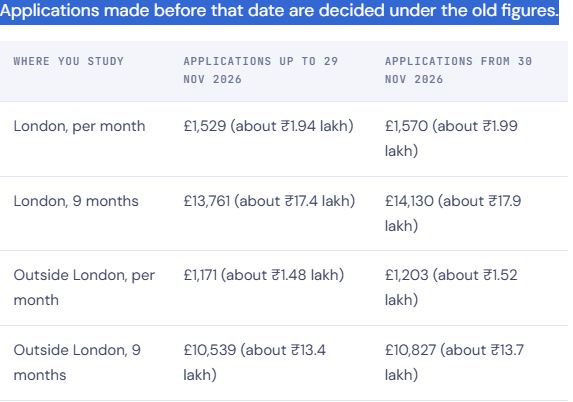
- Applications until 29 November 2026 Living costs Up to 9 months £1,529 a month in London or £1,171 a month outside London.
- Applications from 30 November 2026 Living costs: London: £1,570 per month Outside London: £1,203 per month Up to 9 months.
- The 28-day rule: Money has to be in a bank account for 28 consecutive days ending within 31 days from the day you apply.
- Education loans: a letter of loan is acceptable provided it fits UKVI standards and money covered by a qualifying loan does not need the 28 day history.
UK Student Visa Proof of Funds: How Much is Required?
The GOV.UK Student visa page on money states that you must have enough money to pay for your education and to support yourself. It’s two sections.
1. Your Course Fees
You will need to have enough money to pay your course expenses for one academic year (up to 9 months) The amount will be printed on your CAS. If you have already paid some or all of the fees to your university, this should be reflected by the CAS or you can provide the receipt from the university. What matters is the outstanding sum.
2. Your living costs (‘Financial Requirement’)
The monthly cost depends on where you are studying. “London” means the City of London and the 32 boros of London. Statement of Changes HC 584 An increase to the Immigration Rules increases the amounts for applications made on or after 30 November 2026. Applications received before that date are adjudicated on the previous figures.
Rupee amounts at the RBI reference rate of Rs 126.68 per pound (21 October 2026). “Rates go up and down. Have a 5 to 10% buffer.
The amount is matched to the maintenance loans for UK home students which are evaluated every year so expect it to change again in future years – see explanatory memorandum to HC 584.
If your course is shorter than 9 months you multiply the monthly value by the number of months and round up a part month to a full month (Appendix Student, ST 12.3).
Deduction of Accommodation Deposit
If you have paid a deposit to your university for lodging arranged by them, you can offset that deposit against the living-cost amount, up to a limit. The cap is now £1,529 and under the same regulation modification it rises to £1,570 from 30 November 2026.
The 28-Day Rule and the 31-Day Statement Cycle
These two dates are a common stumbling block for many candidates so be sure to read carefully.
28 days: the money has to be in the account for at least 28 days in a row. UKVI work back from the closing balance on your latest statement.
31 days – the end date of that 28 day period must be within 31 days of the date of your application. In GOV.UK’s own example, if you apply on 1st January, the monies must have been in the account for the 28 days ending on 1st December at the latest.
The balance must not fall below the required amount on any of those 28 days. The rupee balances are converted into pounds at the OANDA spot rate on the date of your application (Appendix Finance, FIN 1.1). A balance that was sufficient may now be insufficient if the rupee has weakened. Another reason to retain a cushion above the minimum.
What is evidence?
The UKVI financial evidence guidance tells you what you are able to use.
Your Money or Your Parents’ Money?
You can utilise money in your name or your parent’s or legal guardian’s name. If you are using a parent’s account, you will need to provide documentation of your relationship and formal permission from that parent or guardian to access the money (Appendix Finance, FIN 5.3). Accepted documents are:
- bank statements (downloads in paper or electronic form)
- passbook for building society
- certificates of deposit
- building society or bank statements
The evidence should include your name (or the account holder’s name), the name of the bank and the amount. The account should provide you instant access to your cash and the bank should be regulated in its own jurisdiction and retain electronic records. If you’re thinking of a fixed deposit, see if it provides rapid access.
What doesn’t count
UKVI will not take money in the form of overdrafts, cryptocurrency, stocks and shares, pensions that you can’t access immediately or promises of future support from a relative or friend.
Loan Letters for Education
The UKVI will accept a student loan from a government, a government-sponsored student loan company, or ‘an academic or educational loans scheme’ from a financial institution that is regulated to provide student loans. For an offshore loan, that means the regulator in the lender’s country. Your lender’s letter of loan must: Under Appendix Finance FIN 9.2
- be dated within 6 months from your application date
- confirm it is a student loan from a government, government supported student loan company or an academic or educational loans plan
- affirm that there are “no conditions on release of the loan funds other than a successful application to study in the UK”
- confirm the amount of the loan and that the loan is in your name
- affirm that the funds will be accessible to you before you go, or paid to your university before you fly with any living-cost part available by the time you arrive
- check the Lender satisfies the regulation criteria above
In India, the regulatory body for banks and NBFCs is RBI. Ask your lender for a letter that addresses each of the following items word by word if possible. A sanction letter with some requirements, such as extra papers prior to payout, may not pass the “no conditions” criteria.
One useful feature is that the 28-day rule does not apply to money which is covered by a student loan meeting these standards (Appendix Student, ST 12.6). You can also mix a loan with savings as long as the savings half fits the 28-day guideline.
Do Indian students need to show financial evidence?
Yes. Some countries’ nationals are exempt from providing financial evidence initially due to the “differential evidence requirement.” India is not on that list on GOV.UK as at 21 October 2026, hence Indian applicants need present full financial evidence with the application.
Extra Costs You’ll Pay When You Apply
The money you show is the evidence of finances, not the money you pay to the UKVI. In addition, you will pay:
- Visa fees: £558 (about £70,700) to apply from outside the UK (GOV.UK Student visa).
- Immigration Health Surcharge (IHS): £776 per year for students (approx. ₹98,300) (GOV.UK IHS). If the visa is for more than a year, but not more than 18 months, you pay the annual cost plus half, which is £1,164 (about ₹1.47 lakh). A one year master will normally be in this band, as a student visa for a term of 12 months or more lasts for around 4 months after the completion of the course.
You can apply up to 6 months before your course starts. The usual decision time from outside the UK is 3 weeks.
How an Education Loan Fits In
Many Indian families use a mix of savings and an education loan to pay for the first year fees and living costs in the UK. A loan sanctioned before the visa application is valid financial proof only if the letter satisfies the above FIN 9.2 standards. Loans are sanctioned at the exclusive discretion of the RBI-regulated Banks and NBFCs and the amount and terms will depend on your profile, course and any collateral you may have.
Useful follow up reads:
- UK education loans: How UK loans operate, what they cover and how to get one
- Collateral-free loan for education in the UK.
- Documents required for education loan to ensure loan and visa procedures go hand in hand.
Consider loan pre-approval before to admission if you wish to know your financing range before you accept an offer.
- Study in the UK: universities, intakes and tuition fees.
Frequently asked questions
What is the minimum bank balance for UK student visa?
Your first year tuition fees + living expenditures for up to 9 months. For applications up to 29 November 2026 that is £1,529 per month in London or £1,171 outside London. For applications from 30 November 2026, it is £1,570 in London or £1,203 outside London.
What is the 28 day rule for UK student visa?
The money must remain in the account for 28 consecutive days, and the last day of that 28-day period must be no more than 31 days after the date of your visa application. It does not apply to money subject to a qualifying student loan;
Can I show my parents bank statement for UK student visa?
“Yup. You will need evidence of your relationship with them and a letter from them stating that they agree to you using the money. Same 28-day and immediate-access rules apply to the account.
Does UK student visa accept university loan as proof of funds?
Yes, providing the loan letter fits UKVI’s standards: it should be dated within 6 months, be from a regulated lender, have no limitations on release other than a successful visa application and have monies accessible prior to you travelling or paid to your university.
Can I show a set deposit for UK student visa?
Certificates of deposit are acceptable proof but the account must be immediately accessible. Don’t take your bank’s terms on your deposit at face value.
UK Student Visa grants amount to alter in 2027?
The sum increases already on 30 November 2026. The Home Office relates this to UK maintenance loans, which are evaluated each year, so check GOV.UK again before you apply.
Figures verified on official government and university websites on 21 October 2026. Confirm requirements before you apply, they change. Fund Abroad is a facilitation and advising platform and not a lender. Loans are sanctioned by RBI licensed banks and NBFCs.